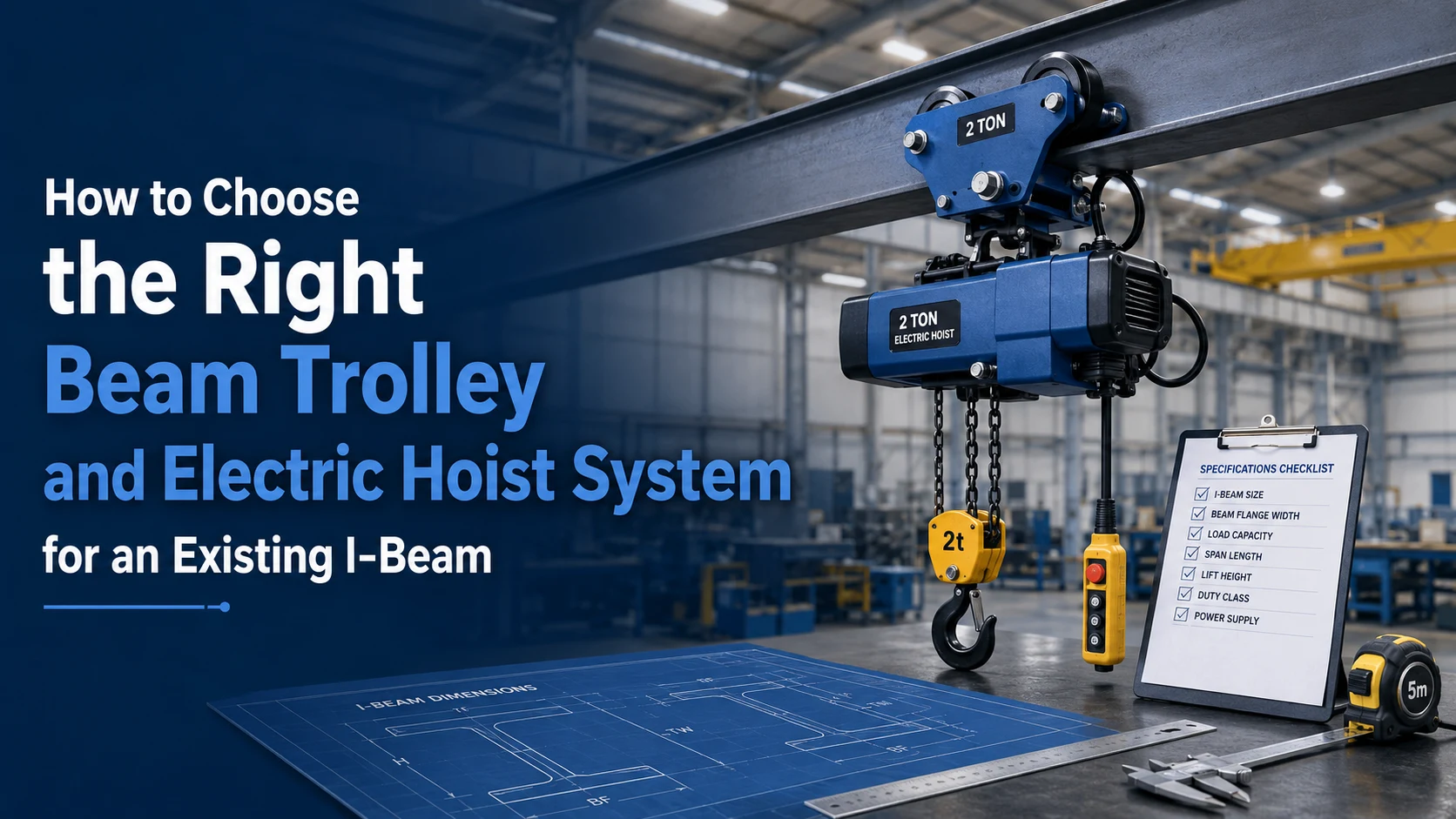
Choosing an electric hoist trolley system for an existing I-beam requires more than matching rated tonnage. Beam profile, wheel spacing, suspension, headroom, travel, power, and operating frequency must work as one system. A trolley may fit the flange but remain unsuitable for the hoist or duty cycle. A sound purchasing process starts with accurate site data and ends with written, model-level compatibility confirmation.
Why Beam Trolley and Electric Hoist Systems Are Often Mismatched
Many purchasing errors begin when capacity is treated as the only meaningful specification. Rated load matters, but attachments and operating conditions also affect duty. Occasional maintenance equipment is not selected like a system moving components repeatedly across a production line.
Another common mistake is judging I-beam trolley compatibility by flange width alone. Manufacturer instructions require the actual width to be measured and trolley spacing adjusted before installation. Specifications may also distinguish flange thickness, profile, wheel clearance, and turning radius. A nominal adjustment range is a starting point, not final approval.
Headroom and mounting geometry are also checked too late. A standard hook-mounted hoist below a trolley may consume more vertical space than an integrated or low-headroom arrangement. Buyers should confirm hook-to-beam dimension, required lift, upper-hook approach, and nearby obstructions before ordering.
Collect These Specifications Before Selecting the System
A useful quotation begins with measurable application data:
- Maximum load and relevant lifting attachments
- Required lift and usable hook height
- I-beam flange width, thickness, and profile
- Straight or curved runway
- Horizontal travel distance
- Expected cycles per shift
- Required lifting and trolley speeds
- Voltage, phase, and frequency
- Operating environment
- Existing model information, drawings, and photographs
Measure the I-Beam and Runway Conditions
Measure the flange at several points. Record width and thickness, identify whether the surface is flat or tapered, and inspect for joints, end stops, obstructions, or damage. For a curved runway, provide the curve radius because not every trolley permits curved travel.
Send the beam dimensions, profile drawing, and photographs to the supplier. Mechanical trolley fit and structural beam capacity are separate decisions: a trolley may physically fit a flange without proving that the supporting structure can carry the intended system and load. Structural adequacy should be confirmed by the responsible engineer or qualified party.
Define Load, Lift, Travel, and Operating Frequency
Record the heaviest expected load, necessary lift, horizontal travel, and frequency of operation. A short movement during occasional maintenance may suit a manual trolley, while frequent movement over a longer runway may justify powered travel.
Positioning matters as well. A process requiring controlled alignment over a fixture may benefit from a geared or slower-speed arrangement even when travel is short. For powered systems, confirm lifting speed, trolley speed, braking, and whether single- or dual-speed control is needed. Avoid universal distance or cycle thresholds; duty and configuration should be verified against the selected product specification.
Confirm Power, Controls, and the Operating Environment
An electric trolley hoist must match the available voltage, phase, and frequency. Also define pendant, radio, or other approved control requirements.
State environmental conditions explicitly. Outdoor exposure, dust, moisture, corrosive substances, temperature extremes, or hazardous locations may require a configuration different from a standard indoor unit. Suitability depends on the exact model and application. Apollo Hoist presents electric hoists, beam trolleys, and related lifting equipment, giving buyers a starting point for comparing product families before requesting model-level confirmation.
Choose Between a Plain, Geared, or Motorized Trolley
The choice should be based on travel distance, frequency, load control, operator position, and operating cost.
| Operating condition | Plain trolley | Geared trolley | Motorized trolley |
|---|---|---|---|
| Short, occasional movement | Often suitable | Optional | Usually unnecessary |
| Controlled manual positioning | Limited | Often suitable | Application-dependent |
| Longer or frequent travel | Less suitable | Possible | Often preferred |
| Repetitive production movement | Inefficient | May slow the process | Commonly evaluated |
| Restricted operator access | May be unsuitable | Hand-chain access required | Remote control may help |
When Manual Travel Is the Better Choice
A plain trolley can be practical when movement is short, infrequent, and easy to control from a safe position. It is less suitable when the load is difficult to start or stop, precise placement is required, or operators must repeatedly push it over a long runway.
A geared trolley uses a hand chain for more controlled movement. It may suit heavier loads or deliberate positioning, but hand-chain drop and operator access must be confirmed. The manual trolley for DCEK and DCER electric hoists publishes model-specific capacity, beam-range, dimensional, and turning-radius information that can be checked against the application instead of relying on a generic manual-trolley description.
When a Motorized Trolley Is Worth the Added Complexity
Motorized travel suits long runways, frequent cycles, repetitive movement, or locations where manual force and access are undesirable. It may be uneconomical for occasional short-distance work.
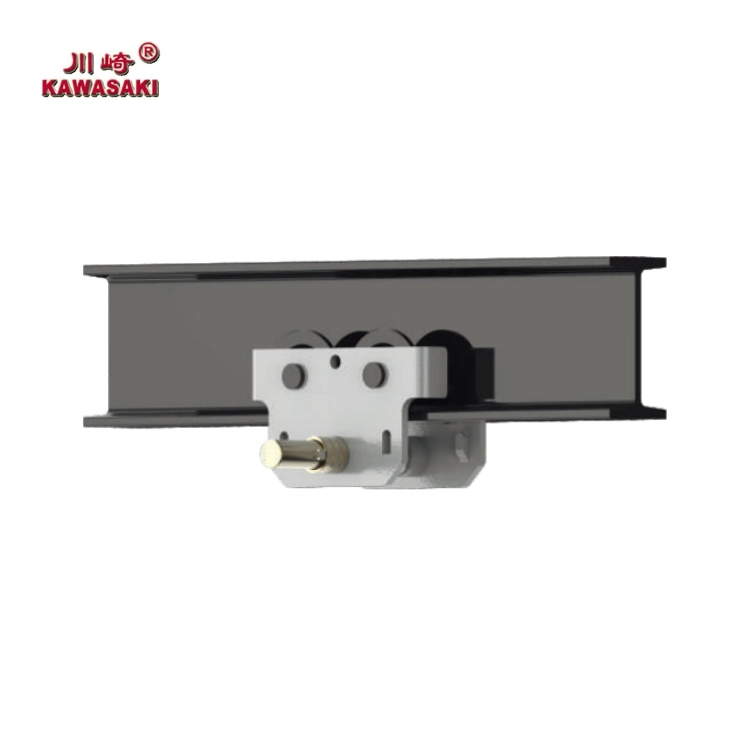
Before purchasing, confirm trolley speed, motor power, frequency, braking, control arrangement, beam range, and turning radius where applicable. The Kawasaki electric trolley line publishes model-level capacities, operating speeds, frequencies, dimensions, and I-beam ranges, illustrating the data buyers should compare before selecting a motorized trolley.
Match the Electric Hoist to the Trolley and I-Beam
Capacity labels alone do not establish compatibility. The hoist, trolley, suspension components, controls, and supporting beam must be treated as a defined combination.
Verify Capacity, Suspension, and Mounting Compatibility
Check whether the hoist uses hook suspension, lug suspension, or an integrated trolley arrangement. A hook that can be physically attached does not prove that the connection is approved. Cross-brand combinations, adapters, or replacement trolleys require mounting dimensions, model information, and written confirmation from the supplier or system designer.
The trolley should not become the lower-rated limiting component. Submit the hoist nameplate, suspension photographs, dimensional drawings, and beam data when matching a trolley to an existing electric hoist. The ET electric trolley for DCEK and DCER hoists is presented as a defined pairing and publishes capacities, speed options, dimensions, turning radii, and I-beam ranges. This is safer than assuming equipment with similar tonnage is universally interchangeable.
Check Headroom and Usable Lifting Height
Measure headroom from the beam running surface to the highest point the load must reach. Compare that space with the complete installed dimensions, not the hoist body alone. A longer load chain increases lift but does not correct an unfavorable hook-to-beam dimension.
Low-headroom or integrated arrangements may be considered above machinery, process tanks, vehicles, or tall fabrications. Where clearance is adequate, the added complexity may be unnecessary. Request a drawing showing trolley, hoist, hook position, and clearances.
Use the Application to Identify the Right Setup
- Short, occasional workshop movement: evaluate a plain trolley with a suitable electric chain hoist.
- Controlled manual positioning: evaluate a geared or controlled manual trolley.
- Long or frequent horizontal travel: evaluate a motorized trolley with compatible controls and power feed.
- Restricted vertical clearance: compare standard and low-headroom installed dimensions.
- Existing-hoist replacement: confirm suspension, model, beam, and control compatibility.
- Difficult environments: request application-specific confirmation rather than assuming a standard unit is suitable.
These are screening directions. Final selection depends on model specifications, beam condition, environment, and system design.
Prevent Fit, Wear, and Operating Problems Before Installation
Incorrect trolley spacing, unsuitable wheel geometry, or incomplete beam data can lead to resistance, poor tracking, flange contact, or uneven wear. Official trolley manuals commonly require the beam flange to be measured and wheel or side-plate spacing set with defined clearance before service.
Request the installation manual, drawing, parts information, and adjustment method for the exact model. Do not use field modification to compensate for an unconfirmed beam profile. If the trolley binds, skews, or contacts an obstruction during initial checks, stop and obtain technical guidance.
Maintenance requirements also belong in the RFQ. For a production-critical lifting point, ask about inspection instructions, replacement parts, electrical documentation, and how wear components will be identified later. Purchase price alone does not reflect the cost of downtime caused by missing documentation.
Decide Between Replacement, Retrofit, and a Complete Package
Reusing an existing hoist may be reasonable when its model, rating, suspension, condition, controls, and documentation are known and a compatible trolley is available. Supply the nameplate, mounting dimensions, beam measurements, wiring information, and clear photographs. Missing identification or an improvised suspension substantially increases uncertainty.
A complete trolley-hoist package may be better when the hoist is obsolete, mounting is unclear, controls need major changes, or compatibility responsibility would be divided. The quotation should identify what is included, how the system matches the beam, and the buyer’s installation responsibilities.
How to Evaluate an Electric Hoist and Trolley Supplier
A qualified supplier should review load, lift, beam dimensions, travel, use frequency, suspension, power, controls, environment, and replacement constraints. Buyers should expect model-level specifications and drawings rather than a quotation based only on tonnage.
Apollo’s public range includes electric and manual lifting equipment, while its trolley pages provide examples of model-specific capacities, beam ranges, speeds, and compatibility statements. The company also presents OEM and ODM services, but any customized voltage, function, finish, packaging, quantity, or special-environment requirement should be confirmed for the exact product.
Compare suppliers on written compatibility confirmation, dimensional drawings, control and power options, installation documentation, spare-parts support, quotation scope, warranty terms, and excluded items. The technical response is often more informative than unit price. A supplier that identifies missing beam or mounting data before quoting can reduce the risk of ordering equipment that cannot be installed as expected.
Conclusion
The right beam trolley and electric hoist system is selected by matching the complete application: load, I-beam dimensions, suspension, travel, operating frequency, headroom, power, controls, and environment. Start with accurate measurements, choose manual or motorized travel according to the work cycle, and require written compatibility confirmation for the exact models.
For a technical review or quotation, contact Apollo Hoist with the required capacity, flange width and thickness, lift height, travel distance, power supply, operating frequency, quantity, existing model information, and available drawings or photographs.
Frequently Asked Questions
Can any electric hoist fit any beam trolley?
No. Capacity is only one factor. Suspension type, mounting dimensions, beam range, trolley geometry, controls, and the approved product combination must also match.
What I-beam dimensions are needed to select a trolley?
Provide flange width, flange thickness, and beam profile. Also state whether the runway is straight or curved and identify joints, end stops, obstructions, and side-clearance limits. Structural capacity must be confirmed separately.
When should a motorized trolley be used?
A motorized trolley is commonly considered for longer travel, frequent cycles, repetitive production movement, or restricted operator access. Plain or geared travel may be more practical for short, occasional movement.
What information is needed for an electric hoist trolley system quotation?
Provide load, lift, headroom, beam dimensions, travel distance, trolley preference, voltage, phase, frequency, operating environment, usage frequency, quantity, and destination market. For replacement projects, add nameplate details, mounting dimensions, wiring information, and photographs.