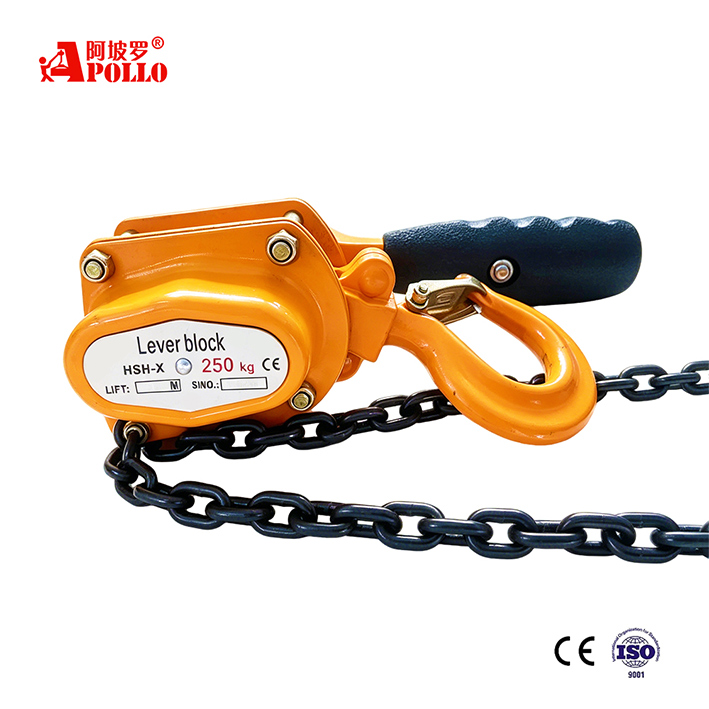
Why Lever Hoist Selection Goes Wrong
Lever hoist jobs go wrong for three reasons. None of them is the tool itself.
- The hoist was chosen for the weight of the load. Nobody added the friction of dragging it. The tool stalls mid-pull, the crew stands around, and the schedule slips.
- The hoist is mechanically fine, but the site safety officer will not let it through the gate without certification documents. No documents, no entry, no work.
- A chain or brake that was never inspected lets go under load. A routine tensioning job becomes an incident report, and a site manager explains downtime to a client.
The good news: every one of these failures is preventable at the buying stage. This guide shows procurement managers, site supervisors, and HSE officers what to check before ordering, what to inspect on delivery, and the features that decide whether a lever hoist lasts ten years or six months.
Get a free load assessment: send your load weight, pulling distance, and site conditions to sales@apollohoist.com and receive a matched capacity recommendation within one business day. Prefer to run the numbers yourself? Ask for the Free Pull Force Calculation Worksheet in the same email.
Lever Hoist vs Hand Chain Hoist: What’s the Difference?
Two tools, two jobs. They look alike on a shelf and work very differently on site.
What the lever hoist does best
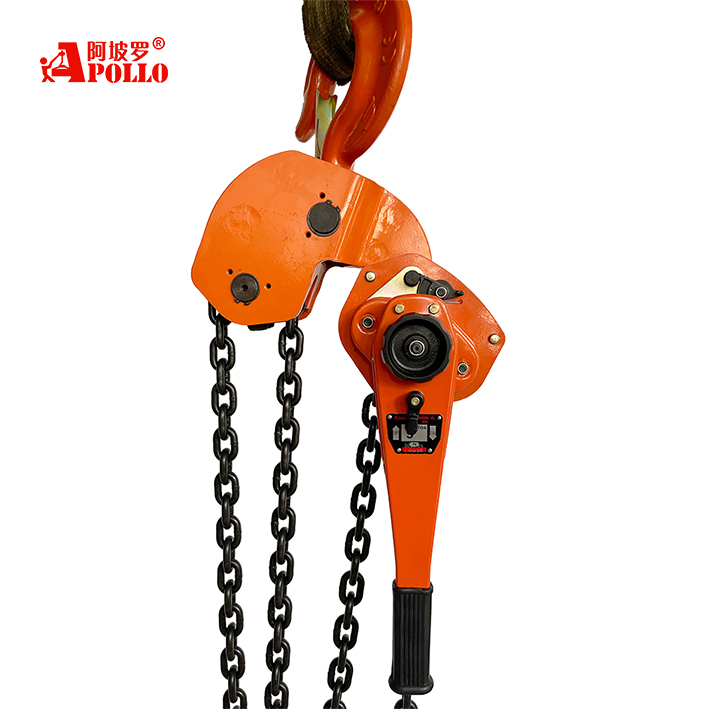
A lever hoist is built for multi-angle lifting and pulling. It lifts, pulls, stretches, and tensions loads from vertical through horizontal. Typical jobs: beam alignment, pipe pulling, cable tensioning, and guy-wire work.
When a chain hoist is the right call
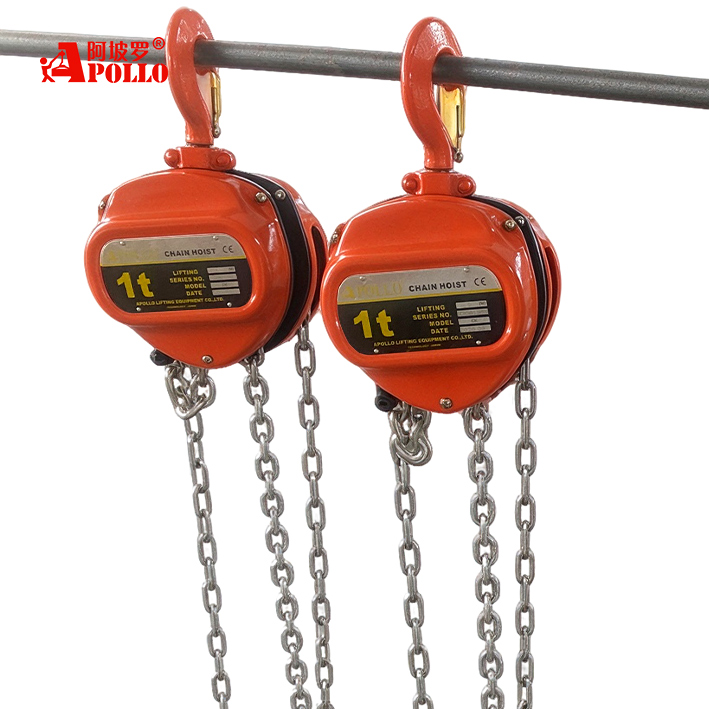
A hand chain hoist is engineered for straight vertical lifting on a fixed hook point. It can tolerate small-angle oblique loads in some situations, but its chain and sheave are not designed for sustained side pull, and most manufacturers discourage it.
When you need both
If the load moves straight up and down, a chain hoist is the economical choice. If it moves sideways, on a slope, or needs tensioning, you need a lever hoist. Most rigging crews carry both, and for good reason.
How to Choose a Lever Hoist: The Buyer’s Checklist
Run through these five steps before you order. They separate a tool that works from a tool that gets returned.
Step 1. Calculate the pull force, not just the load weight
Rated capacity applies whether you lift, pull, or tension. The classic mistake is choosing capacity from load weight alone, because a horizontal pull faces resistance a vertical lift does not:
| Working condition | Pull force factor (x load weight) | Recommended capacity margin |
| Sliding across concrete, dry | 0.4 to 0.6 | At least 1.5x estimated force |
| Rolling on castors, smooth floor | 0.1 to 0.25 | At least 1.5x estimated force |
| Rolling on uneven or debris-covered floor | 0.3 to 0.5 | At least 1.5x estimated force |
| Pulling up a slope | Add load weight x slope % | At least 1.5x estimated force |
| Breaking a stationary load free | Add short-duration peak | At least 1.5x estimated force |
Simple selection logic: estimate the force from the table, then pick a hoist rated at least 50 percent above it. When in doubt, step up one size. Apollo covers 0.75, 1.5, 3, 6, and 9 tons, so stepping up rarely forces a big jump in price or weight.
Real example: a 2-ton beam dragged across a rough deck can need 3 to 4 tons of pull. A hoist chosen for the beam weight alone will stall on site, cost a day of crew time, and often result in a return shipment.
Step 2. Confirm the angle range fits your work
A lever hoist is designed for controlled multi-angle lifting. Keep the load path aligned with the tool’s working axis and apply load smoothly. Shock loading, dropping the lever, or sudden release can momentarily exceed design load even below rated capacity.
Step 3. Verify the chain: Grade 80 and the replacement rule
Lever hoists use high-tensile alloy steel load chain (Grade 80 chain per EN 818-7) because the chain takes both tensile and bending stress in lever operation. Chain wear shows first as elongation, and the chain is the main wear item of the whole tool.
The industry replacement rule: replace the chain when elongation exceeds 5 percent over any 11 consecutive links, or when links show cracks, deformation, twisting, or deep corrosion pitting.
Ask the supplier whether the chain is Grade 80 with material traceability. Chain metallurgy cannot be judged by eye. Substituted lower-grade chain is the most common hidden downgrade in this category.
Step 4. Check the brake and EN 13157 compliance
When the operator releases the lever, the brake holds the load. The compliant baseline is a double-pawl brake: two independent pawls, so a single pawl failure does not release the load.
EN 13157 requires this, plus a minimum 4:1 safety factor and fatigue testing at 1.5 times the working load limit. These are the floor for any compliant tool. The buyer’s job is to verify the documentation proves it.
Step 5. Confirm the hand force your crew can manage
Maximum hand force at rated load ranges from about 140 N (14 kgf) on a 0.75-ton model to about 360 N (37 kgf) on a 9-ton model, measured under EN 13157 test conditions. For frequent use, forces above roughly 300 N (30 kgf) deserve a second look: a two-person procedure, a larger tool with more mechanical advantage, or a powered alternative.
A 360-degree rotating handle and a free-wheeling chain (pulling the hook out by hand when unloaded) make daily positioning faster. Confirm both on the datasheet.
Get a free load assessment: send your load weight, pulling distance, and site conditions via the inquiry page, and Apollo’s engineers will confirm a matched capacity and email EN certificate samples at no cost.
What Separates a Quality Lever Hoist from a Cheap One
Nearly every heavy duty lifting equipment manufacturer can show EN certification and a CE mark. That documentation is the entry ticket, not the differentiator. What separates tools that last from tools that get replaced is how the certified design is built:
| Check | Why it matters | What Apollo does |
| Weight at capacity | Carried up scaffolding, into tight spaces | 0.75-ton model weighs 7.5 kg and lifts 750 kg |
| Chain spec | Main wear item, main hidden downgrade | Grade 80 alloy chain, 6 to 10 mm, traceable |
| Free-wheeling | Ratcheting wastes 30-60 seconds per cycle | Standard on all models |
| Handle | Fixed handles force awkward angles | 360-degree rotating handle as standard |
| Verification | Certification is only as good as the paper | EN 13157 certificate with each shipment, ISO 9001 factory |
Explosive atmospheres: a standard lever hoist is not rated for them. Specify an EX-rated variant at inquiry and confirm the rating applies to the model shipped.
5-minute acceptance check on delivery: confirm both brake pawls click under load, the brake holds a test load without creeping, the free-wheel operates only when unloaded, and the certificate serial number matches the unit.
Operate and Maintain: Safety Rules That Keep Your Crew Safe
A compliant tool, a trained operator, and a maintained schedule make the safe combination. Accidents come from the three lining up badly, not from a single cause.
- NEVERuse a lever hoist to lift or support people.
- NEVERexceed rated capacity at any point in the operating cycle.
- NEVERuse a non-EX tool in an explosive atmosphere.
- NEVERshock-load by dropping the lever or jerking the chain.
Before every use: check hook latches, chain condition, brake function, and housing. Keep the load path aligned with the tool axis. Maintain on schedule: a competent-person inspection at least every 12 months, more often under intensive use, plus re-inspection after any overload or incident. Use the lever hoist as a working tool, not as a permanent support.
Three Questions to Ask Any Supplier
Any lever hoist manufacturer and supplier should answer these three before you order:
- Can you send the EN 13157 certification and test documents before I order? Apollo sends the full package with each shipment and shares samples on request.
- What chain does the hoist use, and can you trace it? Apollo uses Grade 80 chain with material traceability.
- Do you stock replacement chain, brake assemblies, and hooks? These are wear items over a 10-year service life; Apollo stocks spares for the full range.
Apollo has manufactured lifting equipment for over 20 years, exporting to more than 50 countries, with factory-direct production and OEM support.
Get the Free Lever Hoist Selection Kit
Two free resources, no sign-up wall. Email sales@apollohoist.com with the subject line “Free Lever Hoist Kit” and receive both files the same business day:
- Free Pull Force Calculation Worksheet: a one-page worksheet with the friction factors, slope adjustments, and 1.5x margin rule from this guide, formatted for your next rigging plan.
- Full Lever Hoist Selection PDF: the complete selection guide with capacity tables, EN 13157 acceptance checks, and delivery inspection checklists, ready to share with your HSE team.
How to Buy from Apollo: Choose Your Channel
Project procurement and site teams
Get a free load assessment: tell us your application, maximum load or pull force, and site conditions. Within one business day you will receive a matched capacity recommendation, a formal quotation, and the EN 13157 certification documents your HSE officer needs.
Distributors and dealers
Stock the full 0.75 to 9-ton range under one certification package, with multi-product quotes that combine lever hoists with chain hoists and trolleys. Factory-direct pricing protects your margin.
OEM and private label
Custom branding, packaging, and documentation are available from the Apollo factory, built to your market’s compliance requirements.
Request EN Certificate Samples Now
- Get a free load assessment via WhatsApp / Phone: +86 18989488615
- Request EN certificate samples by email: sales@apollohoist.com
- Submit an online inquiry: https://www.apollohoist.com/contact-us/
- Browse the full product range: https://www.apollohoist.com