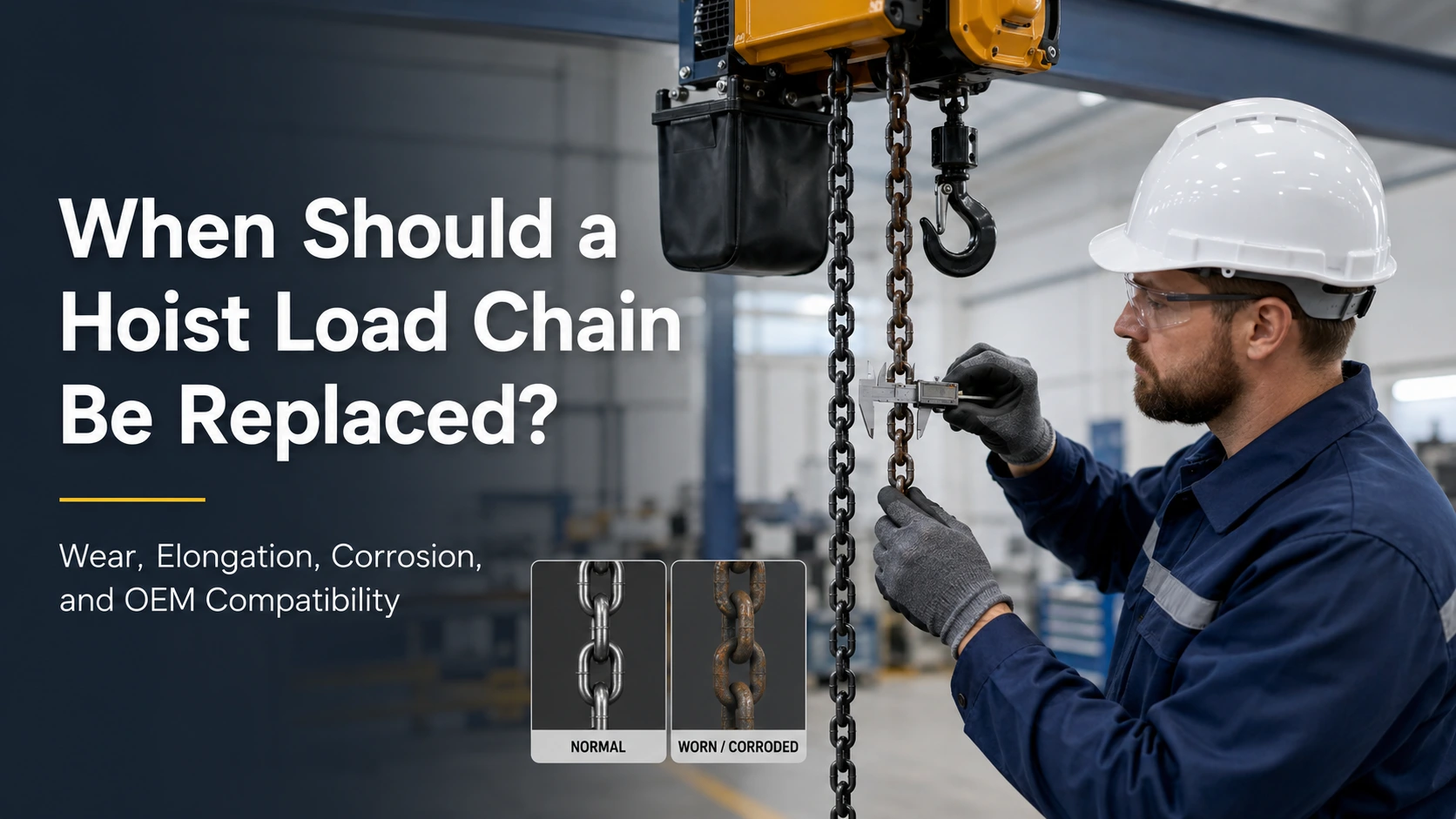
Hoist load chain replacement should begin as soon as an inspection finds cracking, twisting, severe corrosion, binding, or dimensions outside the limit specified for the exact hoist model. Wear or suspected elongation usually requires cleaning and measurement before a decision can be made. There is no single percentage limit that applies to every chain hoist.
A hoist load chain is also not interchangeable with a chain sling or general-purpose lifting chain. OSHA defines hoist chain as the load-bearing chain inside a hoist and notes that its properties differ from chains covered by the sling standard. ASME B30.16 separately addresses inspection, maintenance, and replacement for powered and manual chain hoists.
When Must a Hoist Load Chain Be Replaced?
Defects That Require Immediate Removal From Service
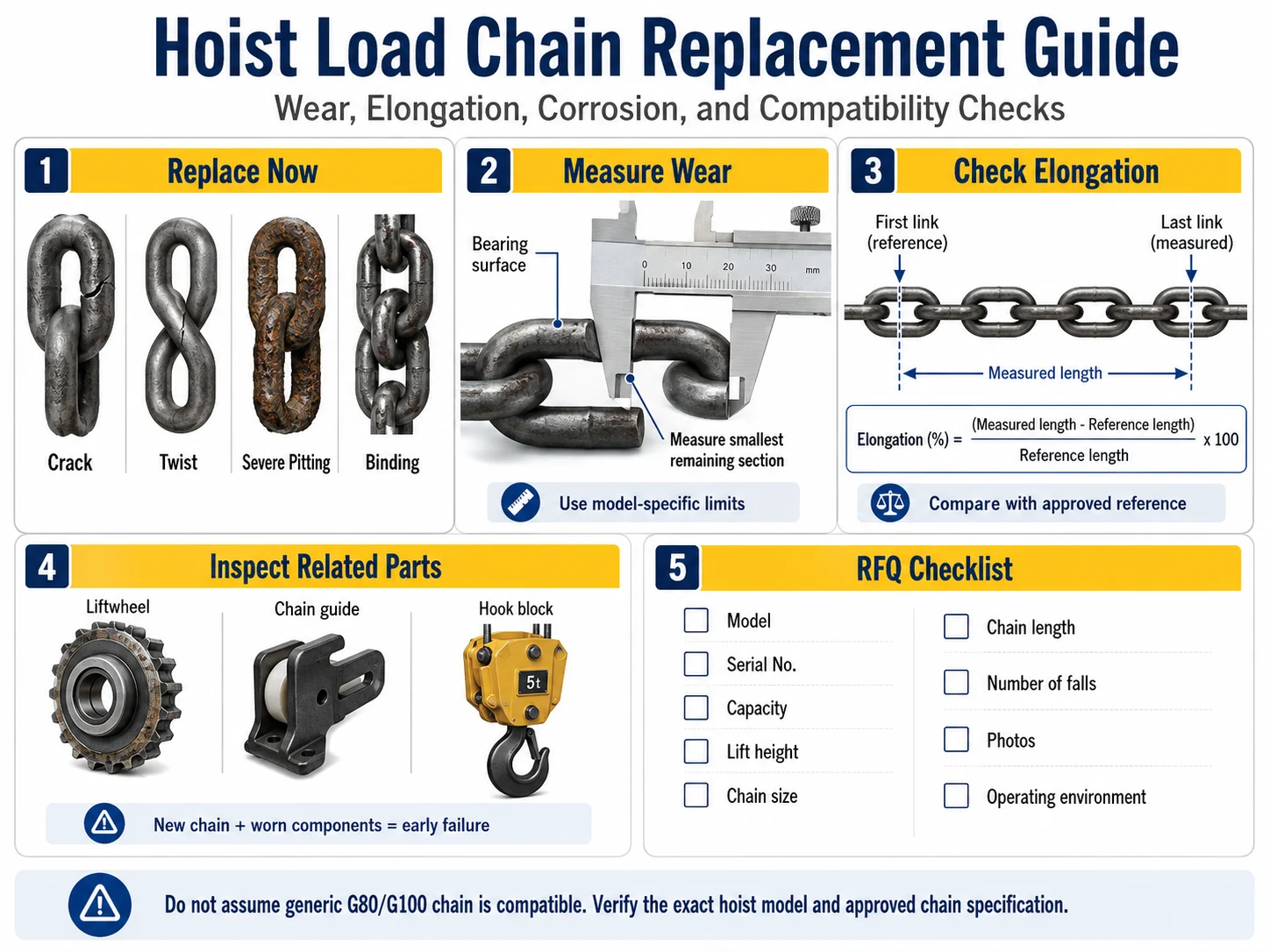
Remove the hoist from service when a chain link is cracked, severely nicked, twisted, bent, heat-damaged, or visibly deformed. A link that no longer articulates freely, repeatedly jams in the chain guide, or jumps as it enters the liftwheel also indicates that continued operation could cause further damage or loss of load control.
Severe pitting, flaking corrosion, or obvious cross-section loss should not be treated as a cosmetic issue. The equipment should be tagged, isolated, and assessed by qualified personnel. A single badly damaged load-bearing link cannot be ignored because the chain functions as one continuous load path.
Do not estimate how many additional lifts the chain can complete. Do not straighten, heat, weld, or grind a damaged link back into shape. Manufacturer guidance for chain hoists generally calls for a damaged or worn load chain to be replaced as a complete, correctly sized length rather than repaired with a connector or individual replacement link.
Conditions That Require Measurement or Further Assessment
Some findings do not establish replacement by appearance alone. Polished bearing surfaces, suspected elongation, minor surface rust, shallow marks, or localized wear may require cleaning and dimensional measurement.
Keep the hoist out of service while the condition is unresolved. Compare measurements with the operating manual, an approved inspection gauge, a manufacturer’s dimensional table, or an unworn reference section where the prescribed procedure permits it. If no reliable limit is available, contact the hoist or chain supplier rather than applying a percentage found in an unrelated manual.
Hoist Load Chain vs. Rigging Chain
Chain Geometry and Liftwheel Compatibility
A hoist chain must move through a precisely shaped liftwheel, chain guide, and load path. Compatibility therefore depends on more than diameter or rated capacity. Pitch, inside width, outside width, link shape, dimensional tolerance, weld position, material, heat treatment, and surface condition can all affect engagement with the liftwheel.
A chain that is slightly different may ride high in the pockets, bind in the guide, generate abnormal noise, or wear unevenly. It may appear suitable while unloaded but fail to track correctly when tension increases.
This is why the purchasing request should identify the hoist manufacturer, model, serial number, capacity, lift height, number of chain falls, and existing chain part number. A sample link or basic diameter measurement should not replace model identification.
Why Generic G80 or G100 Chain May Not Be Compatible
Grade 80 or Grade 100 describes part of a chain’s material and strength classification. It does not establish that the chain has the geometry, tolerances, heat treatment, or manufacturing controls required by a particular electric chain hoist.
A general lifting chain with an adequate working load limit may still be unsuitable for a powered liftwheel. Inspection gauges intended for rigging chain should not automatically be used for hoist load chain, and vice versa. Manufacturer technical guidance distinguishes the two because their design behavior and inspection references differ.
A non-original chain should be considered only when the supplier can provide written confirmation that it is approved for the exact hoist model and configuration. Matching only the grade, nominal diameter, or capacity is not enough.
How to Measure Hoist Chain Wear and Elongation
Measure Link Wear at the Bearing Surfaces
Clean the chain using a method allowed by the manufacturer so dirt, dried lubricant, and corrosion products do not conceal damage. Do not use aggressive cleaning or grinding that could remove material or hide cracks.
Wear commonly develops where adjacent links contact one another and where links engage the liftwheel. Collapse or rotate the chain enough to expose these bearing surfaces, then measure the smallest remaining section using the tool specified in the manual. A narrow-tip or knife-edge caliper may be needed to reach an internal worn area.
Take measurements in more than one direction when the link appears oval or unevenly worn. Record the lowest value, the location, the tool used, and the reference limit. Chain dimensions vary among hoists, so the correct minimum section must come from model-specific documentation. Manufacturer inspection guidance specifically advises users to refer to the applicable operation and maintenance manual because chain sizes and measurement requirements vary.
Measure Elongation Across the Specified Number of Links
Elongation is normally assessed across a defined number of pitches or links rather than estimated from the overall hanging length. The chain should be positioned and lightly tensioned exactly as directed by the relevant manual so each inspection is repeatable.
A general calculation is:
Elongation (%) = (Measured length − Reference length) ÷ Reference length × 100
The formula calculates dimensional change; it does not set the rejection limit. The reference may be an approved new-chain dimension, an unworn section, or a table in the manufacturer’s manual.
Measure the exact number of links specified for the model. A significant change in a few links can be hidden when a much longer length is measured, while measuring too few links may exaggerate normal tolerance. Record both the measured length and the reference used.
Why There Is No Universal Elongation Limit
Online guidance may mention limits such as 1.5%, 2%, 3%, or 5%. These numbers may refer to different hoists, different chain sizes, a single-link pitch, a multi-link gauge length, or another chain application entirely.
Some manuals use maximum multi-pitch length. Others use minimum remaining link diameter or a combination of dimensional limits. The number of measured links and the reference condition also vary. Applying a limit from another manufacturer or a chain-sling inspection table can produce the wrong decision.
Use the exact acceptance criteria for the hoist model. ASME B30.16 provides the broader inspection and maintenance framework, but the product documentation supplies the dimensions and procedures required for a specific chain.
When Does Corrosion Require Chain Replacement?
Surface Rust vs. Structural Pitting
Light surface contamination or discoloration may sometimes be cleaned for further inspection, provided the method is approved. After cleaning, inspect every accessible surface for pits, cracks, stiffness, flaking, and reduced cross-section.
Pitting is more serious than uniform staining because it creates localized section loss and stress concentration. A chain showing deep pits, corrosion at the interlink bearing points, seized links, or dimensions below the approved minimum should be removed from service.
Do not aggressively polish the chain until it appears smooth. Material removal can reduce the section further and conceal the original defect. When corrosion severity cannot be measured reliably, a conservative replacement decision is appropriate.
Preventing Repeated Corrosion
Repeated corrosion may indicate that the chain finish, lubricant, storage method, or complete hoist configuration is unsuitable for the environment. Record exposure to humidity, washdown, salt, chemicals, outdoor weather, or temperature extremes when requesting replacement parts.
Different materials and finishes cannot be substituted solely because one appears more corrosion resistant. The finish must remain compatible with chain dimensions, liftwheel engagement, mechanical properties, and the manufacturer’s approved configuration.
For example, the KKBB electric chain hoist page lists different chain material and surface-treatment options. A replacement should still be confirmed against the exact hoist, liftwheel, operating environment, and approved parts information rather than selected by finish alone.
What Else Must Be Inspected When Replacing the Chain?
Liftwheel, Chain Guide, and Hook Block
A worn load chain may damage—or be damaged by—the parts through which it travels. Inspect the liftwheel pockets for grooves, burrs, sharp edges, uneven wear, and distorted profiles. Check the chain guide for cracking, misalignment, excessive clearance, and evidence that the chain has rubbed against one side.
On multiple-fall systems, inspect the lower hook block, idler wheel, chain anchorage, and all reeving points. Installing a new chain over a badly worn liftwheel can cause noise, poor seating, accelerated elongation, and early replacement.
Manufacturer maintenance manuals commonly direct users to inspect the load sprocket and related chain-running components when chain deterioration is found.
Reeving and Localized Wear
Confirm that the chain is not twisted and that every standing link enters the guide in the required orientation. Reeving patterns, weld orientation, end connections, and multiple-fall arrangements vary by model; use the correct manual rather than a generic installation diagram.
Localized wear may occur when the hoist repeatedly operates through the same short travel range. A small group of links then engages the liftwheel far more often than the rest of the chain. Inspection should cover the complete working length, not only the section visible near the hook.
After installation, operate the hoist without a load through its full travel according to the manufacturer’s instructions. Stop if the chain binds, jumps, twists, or produces abnormal noise. Do not use a suspended load to force an incompatible chain to “wear in.”
How to Order the Correct Replacement Hoist Chain
A replacement-chain RFQ should include:
- Hoist manufacturer, model, and serial number
- Rated capacity and lifting height
- Number of chain falls
- Existing load-chain part number
- Nominal link diameter and pitch
- Inside and outside link width
- Required chain length
- Chain finish and operating environment
- Photographs of the nameplate, chain, liftwheel, and damage
- Manual reference, if available
Ask whether the proposed chain is approved for the stated model, whether the liftwheel or guide requires measurement, and whether any associated parts should be replaced. Confirm how chain length is calculated, including free-end requirements, hook-block reeving, and the chain container.
Hangzhou Apollo Lifting Equipment Co., Ltd. publishes chain-hoist and load-chain product categories through its industrial lifting equipment manufacturer website. These categories establish product relevance, but model-level compatibility should still be verified in writing before an order is placed.
Replace the Chain or Replace the Complete Hoist?
| Equipment condition | Practical decision path |
|---|---|
| Chain is outside limits; related components remain serviceable | Install an approved replacement chain |
| Chain, liftwheel, and guide are worn | Evaluate replacement of the chain-running system |
| A previous replacement chain wore unusually quickly | Investigate compatibility, alignment, duty, and environment |
| Model is obsolete and approved parts or manuals are unavailable | Consider complete-hoist replacement |
| Chain damage accompanies brake, control, structural, or suspension defects | Compare full repair cost and downtime with replacement |
If the existing unit no longer has reliable documentation, compatible parts, or an economical repair path, compare the electric chain hoist range using capacity, lift height, voltage, duty, mounting, trolley arrangement, headroom, controls, and environment. Do not choose a replacement hoist by capacity alone.
Conclusion
Replace a hoist load chain immediately when it has critical damage, and measure uncertain wear or elongation against the exact model’s approved limits. Confirm liftwheel, guide, reeving, and chain compatibility before returning the equipment to service.
To identify a suitable part or replacement configuration, request a load chain compatibility check and provide the hoist model, serial number, capacity, lift height, number of falls, chain dimensions, environment, manual reference, and clear damage photographs.
Frequently Asked Questions
Can one damaged hoist chain link be replaced?
A load-bearing hoist chain should not be patched with a connector, welded link, or individual substitute link. Isolate the hoist and follow the manufacturer’s instructions for replacement with one correctly specified chain length.
Can Grade 80 chain be used in any electric chain hoist?
No. The grade does not confirm pitch, width, dimensional tolerance, heat treatment, or liftwheel compatibility. The chain must be approved for the exact hoist model.
How many links should be measured for chain elongation?
The required number varies by hoist and chain. Use the link count, chain condition, applied tension, and maximum dimension stated in the model’s operating or maintenance manual.
Can a rusty hoist chain be cleaned and reused?
Minor surface contamination may be cleaned using an approved method and reinspected. Pitting, section loss, cracks, stiff links, or measurements outside the manufacturer’s limits require removal from service.
Does the liftwheel need to be replaced with the load chain?
Not automatically, but it must be inspected. Worn pockets, grooves, burrs, or an incorrect profile can damage the new chain and cause poor engagement.