The Jack That Will Not Fit Under the Car
A customer rolls a lowered sports car into the workshop. The standard 3-ton jack slides under the front lip and stops: 30 mm too tall. The technician reaches for wooden blocks to raise the car first, and everyone watching knows that is the moment jacks slide and panels get crushed.
Low-clearance vehicles are not a niche. Sports cars, modified suspensions, and low-floor vans are daily work for many shops, and the fix is not extra skill, it is the right specification:
- It does not fit.A jack with a 100 mm minimum height cannot get under a car with an 85 mm gap, no matter how the technician angles it.
- Blocking is the danger.Wood blocks slide, split, and crush. Every lift on blocks is a lift that can drop the car onto the floor.
- Scraped panels.Forcing a tall jack under a low front lip scratches the bumper and the underbody, and the shop pays for the repair.
- Wrong purchase, second purchase.Buying on tonnage alone and ignoring height means a return shipment and a stopped job.
This guide is for workshop owners, fleet managers, and maintenance supervisors who lift low vehicles or equipment every day. It explains how minimum height decides fit, which vehicles need an 80 mm profile, and the design details that separate a jack that lasts from one that leaks.
Get a free load assessment: send your lowest vehicle and typical lift points to sales@apollohoist.com, and receive a matched jack recommendation within one business day.
Why Minimum Height Decides Whether a Jack Fits
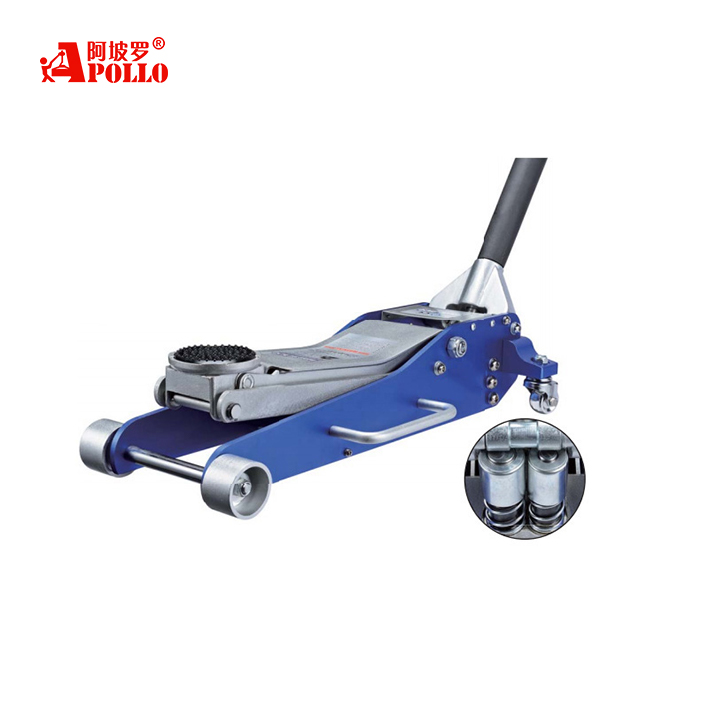
Minimum height is how low the lifting saddle sits when the jack is fully lowered. If that number is higher than the gap under the vehicle, the jack physically cannot get into position. For a 3-ton Apollo floor jack, that number is 80 mm, about 3.1 inches, which clears most sports cars and lowered suspensions without blocks.
The fit check is simple arithmetic: measure the lowest point of the vehicle, subtract the jack’s minimum height, and the remainder is your clearance margin. An 80 mm jack under a 110 mm underbody gap leaves 30 mm to work with. A 135 mm jack would not fit at all.
Reference points: most lowered sports cars sit 70 to 90 mm at the front splitter, standard sedans 120 to 150 mm, and SUVs 180 to 220 mm. If your lowest vehicle falls in the first group, the 80 mm profile is not a luxury – it is the only jack that gets under the car without blocks.
| Jack minimum height | Typical fit |
| 80 mm | Sports cars, modified suspensions, low-floor vans |
| 100 to 110 mm | Most sedans, SUVs, and light trucks |
| 135 mm | Pickups and vans, often needs blocks for low cars |
| 140 mm and above | Heavy vehicles, requires dedicated tooling |
The industry baseline for mobile jacks in Europe is EN 1494, which sets the safety requirements and test loads. Apollo floor jacks carry CE and GS certification and are load-tested at 125 percent of rated capacity before shipment. That is the entry ticket any industrial buyer should expect and confirm in writing.
Quick decision guide: an 80 mm profile jack is essential if your lowest vehicle sits under 100 mm, if you regularly service sports cars or modified suspensions, or if floor-level equipment is part of your workload. A standard 135 mm jack is fine for normal sedans, SUVs, and light commercial vehicles where ground clearance is not the constraint.
How to Match a Low-Profile Jack to Your Workshop
Sports cars and modified suspensions
Lowered cars are where the 80 mm profile earns its keep. Check the front splitter, side skirts, and exhaust tips, the three lowest points, and confirm the jack clears all of them. Also confirm the lift height is enough to reach your stands once the car is up.
Low-floor commercial vans
Delivery vans and low-floor models sit close to the ground for loading convenience, and their wheelbases are long. A low-profile jack with enough lift height handles both the fit and the working clearance in one unit.
Mixed fleets and industrial equipment
If your shop serves cars, vans, and equipment, match the jack to the lowest vehicle, not the heaviest. A 3-ton low-profile jack covers most of the range; keep the 5-ton for heavy equipment where height is not the constraint. For the full 2 to 5-ton options, browse the Apollo lifting jack range (https://www.apollohoist.com/product-category/lifting-jack/).
Lift height is the other half of the fit check. A low-profile jack often trades maximum lift for minimum height, so confirm the fully raised saddle clears your axle stands. A 3-ton Apollo low-profile jack reaches about 380 mm, which covers most cars and vans – but check your tallest stand before you commit.
Get a free load assessment: send your lowest vehicle and typical lift points via the inquiry page, and Apollo’s engineers will confirm the right jack configuration and email test samples at no cost.
Pumping effort adds up on a busy day. A single-piston low-profile jack can take 30 or more strokes to reach working height. A dual-piston pump cuts that roughly in half by moving more fluid per stroke on the no-load and light-load range – worth having if your crew lifts five or more cars a day.
Handle length matters for both leverage and clearance. A two-piece handle lets you remove the upper section when working under low side skirts, while the full length gives enough leverage for heavy loads. Look for a foam grip that stays comfortable during repeated pumping, and a handle that locks upright so it does not fall and scratch a paint panel.
What Separates a Quality Hydraulic Jack from a Cheap One
Nearly every heavy duty lifting equipment manufacturer can show EN certification. Certification is the entry ticket, not the differentiator. What separates a jack that still holds pressure in year five from one that weeps fluid in month three is how the certified design is built:
- Thickened steel frame.A stamped one-piece frame resists twisting better than thin welded plate.
- Dual-seal cylinder.A dust seal in front keeps grinding dirt away from the pressure seal, which is the main cause of leaks.
- Built-in overload valve.Excess pressure vents back to the reservoir instead of building until a seal blows. The valve is calibrated per unit at the factory.
- Per-unit testing.Every jack is load-tested at 125 percent of rated capacity before shipment, with records available per order.
Wide stable base. A broad footprint with a low centre of gravity resists tipping on uneven or greasy workshop floors, and the saddle should rotate to match the lift point angle without sliding off.
The overload valve deserves its own guide: see how a failed valve drops a load in seconds (https://www.apollohoist.com/product-news/hydraulic-jack-overload-valve-guide-stop-load-drops-before-they-happen-apollo-lifting-equipment-manufacturer/).
Floor condition affects safety on any jack. Cracked concrete, oily surfaces, and uneven floors reduce stability – always place the jack on a flat, clean, dry surface, and use a jack pad if the lift point is plastic or fragile.
Three Questions to Ask Any Supplier
Certification depth matters beyond the stamp. A credible supplier provides EN 1494 compliance, CE and GS marks, and per-unit load test certificates – not a single factory-wide document. Ask for the test record matched to your jack serial number, and confirm the 125 percent overload test was run on your exact unit.
Any hydraulic jack manufacturer and supplier should answer these three before you order:
- Can you send the load-test and calibration records before I order?Apollo tests every jack at 125 percent of rated capacity, and the records are available with each order.
- What is the minimum height on the tonnage I need?Confirm the number in writing against your lowest vehicle before you commit.
- Do you stock seals and service parts?Replacement seals and valve service guidance are available for the full Apollo floor jack range.
Apollo has manufactured lifting equipment for over 20 years, exporting to more than 50 countries, with factory-direct production and OEM support. See the full product range (https://www.apollohoist.com/product/).
How to Buy from Apollo: Choose Your Channel
Workshop and fleet procurement
Get a free load assessment: tell us your lowest vehicle, typical lift points, and tonnage needs. Within one business day you will receive a matched jack configuration recommendation, a formal quotation, and the test documents your safety officer needs.
Distributors and dealers
Stock the full 2 to 5-ton range under one certification package, with multi-product quotes that combine floor jacks with chain hoists and trolleys. Factory-direct pricing protects your margin.
OEM and private label
Custom branding, packaging, and documentation are available from the Apollo factory, built to your market’s compliance requirements.
Request EN Certificate Samples Now
- Get a free load assessment via WhatsApp / Phone: +86 18989488615
- Request EN certificate samples by email: sales@apollohoist.com
- Submit an online inquiry: https://www.apollohoist.com/contact-us/
- Browse the full product range: https://www.apollohoist.com