The pull that gives way without a bang
A crew is tensioning cross bracing on a steel frame. The lever handle feels normal all morning. By the afternoon break the bracing has gone slack, the handle comes back further than it should before the load takes up, and nobody can say when the change started. The tool did not break. It had been holding on less than it was designed to hold, and the crew only found out when the tension went out of the job.
Lever hoists are inspected far less often than they are used, for a reason that sounds sensible: nothing about a manual tool looks like it needs a service. There is no motor, no hydraulic fluid, no filter. What there is, is a brake that holds silently, a chain that stretches slowly, and a pawl spring that weakens without announcing itself.
Inspection gets skipped for four reasons:
- The tool passes a visual check, and a visual check cannot see pawl engagement or chain elongation.
- The last inspection has no date on it, so nobody knows whether it was last month or three years ago.
- The unit is shared between crews, which means each crew assumes another one is responsible for it.
- A symptom is explained away, because a handle that needs an extra stroke is easy to blame on the load rather than the tool.
This guide is written for maintenance supervisors, rigging crew leaders, site safety officers and distributors who have to keep manual pulling tools in service and prove it. It sets out what an inspection actually looks for, how to judge pass from fail, and which findings take a unit out of service rather than onto next month’s list.
Get a free load assessment: send the capacity, the application and the inspection regime your site follows to sales@apollohoist.com, and receive a matched Apollo lever hoist recommendation with the wear-part list within one business day.
Three inspections, three different jobs
Before each use: the operator, two minutes
This is not an inspection in the formal sense, and it is the one that catches most problems. The operator checks the chain for twists and stiff links, confirms the hook latches close on their own, pulls a light test load to confirm the brake holds, and listens for a chain that clicks as it runs. Anything unexpected stops the lift, and the unit goes to the supervisor rather than back on the beam.
Monthly: the supervisor’s walk-round
The monthly check looks at the things an operator has no reason to notice: pawl engagement with the cover off where the design allows it, wear on the hooks, the condition of the chain where it sits against the sheave, the free-wheeling changeover, and the legibility of the capacity marking. This is also where the unit’s history gets written down, because a symptom without a date cannot be trended.
Annually: the competent person’s record
The annual inspection is a documented examination by a competent person, and it is the record that survives an audit. It covers the brake strip-down, chain measurement, hook and latch assessment, and a look at the body and load plates for cracks or deformation. It happens again after any overload, any incident, and any period out of service, regardless of the calendar.
What to check, part by part
Load chain and chain guide
Measure elongation rather than judging by appearance. The working rule is the same one used across manual lifting equipment: replace the chain at about 5 percent elongation, or when 11 links measure the length that 10 links measured when the chain was new. Alongside the measurement, look for cracked or nicked links, corrosion pitting, and a chain that has jumped its guide. A twisted link is a replacement, not a straightening job.
Brake and pawls
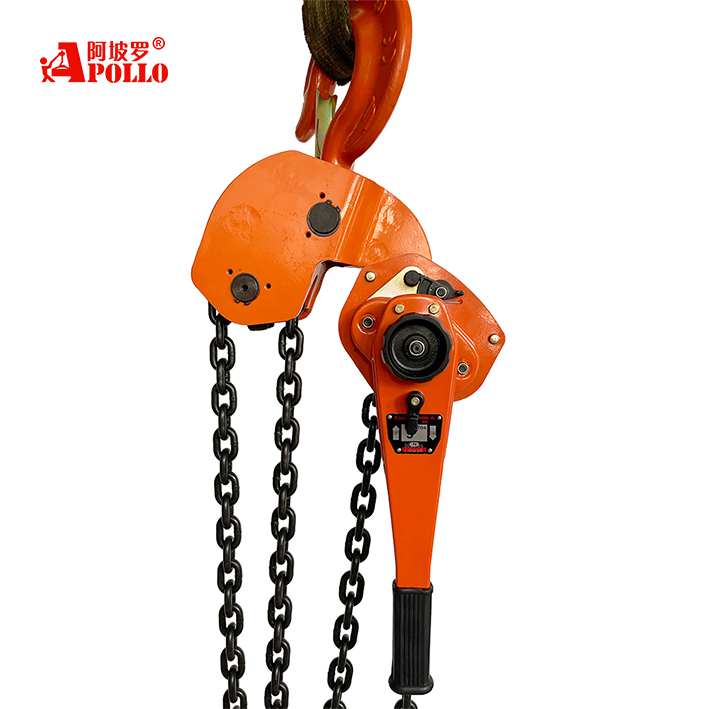
Apollo lever hoists use a double-pawl brake, so two independent locking elements hold the load and no single component can release it. Inspection confirms that both pawls move freely, that their teeth are square rather than rounded, and that the springs return them into engagement. Then the functional test: lift a light load, release the handle, and watch. A load that creeps is a brake that is no longer doing its job.
Free-wheeling mechanism
Free-wheeling is what lets a technician pull chain through the body by hand before the loaded pull begins. It is also the part most often forced. Check that the changeover moves fully into each position, that it does not slip out under load, and that the mechanism is clean. Forcing the changeover while the chain is loaded is how a working feature becomes a repair.
Handle, gear train and load plates
Open the handle through its full stroke and feel for a catch or a step, which points to a damaged tooth rather than a worn one. Check the load plates for cracks, elongation of the pin holes, and any sign of heat or welding. Heat-treated plates and gears hold their profile through repetitive shock loading, but they do not survive being straightened or welded back into shape.
Hooks and latches
Both hooks are forged with steel safety latches on Apollo units. Check that each latch closes on its own and sits against the hook tip, that the throat has not opened measurably, and that there is no twist. A hook that has been heated, straightened or welded is scrap, whatever its dimensions say.
Symptom, cause, and what to do
Most inspections start with something the crew noticed rather than with a checklist. These five symptoms cover the majority of what a lever hoist reports before it stops working.
| What you notice | Likely cause | What to do |
| The load creeps down after the handle is released | Pawls not engaging, or pawl teeth worn round | Out of service until the brake is stripped and assessed |
| The handle feels spongy before the load moves | Worn gear teeth, or a stretched chain sitting high in the sheave | Measure chain elongation and inspect the gear train together |
| The chain clicks or jumps under load | Worn sheave pockets, a twisted link, or a chain out of its guide | Stop the lift and inspect chain and sheave as a pair |
| Free-wheeling will not engage or will not release | Contaminated or worn changeover mechanism | Clean and inspect; never force the changeover under load |
| The latch hangs open | Bent latch, dirt, or a deformed hook throat | Replace the latch; scrap a hook that is twisted or opened |
Read the table from right to left when you plan the repair. A symptom that resolves to a wear part is a scheduled job. A symptom that resolves to the body, the plates or a hook is a replacement decision, because those parts carry the certification of the unit.
What takes a lever hoist out of service
The distinction that matters in an inspection is not between worn and new, but between worn and unsafe. Four findings take a unit out of service immediately: a load that creeps with the handle released, a chain at or past its elongation limit, a hook that is twisted, opened or welded, and any crack in the body or the load plates. A fifth finding, a latch that will not close, takes the unit out of service until the latch is replaced, because a hook without a working latch is a hook that can slip out of a sling.
Everything else can be scheduled, provided it is written down with a date and an owner. The failure mode that audits catch is not a worn part. It is a worn part with no record, on a unit that everyone assumed someone else had checked.
Records: the part everyone skips
An inspection that is not recorded did not happen, as far as a site audit is concerned. The record needs five fields and no more: the unit identifier, the date, the inspector, what was found, and what was done about it. A photo of a worn pawl is worth more than a paragraph describing it, and a scanned sheet in the same file as the beam inspections is worth more than a folder in a drawer.
Documentation is where a supplier either helps or hinders. Ask what ships with the unit, what the certificate covers, and whether the inspection guidance is specific to the model rather than generic. The wider question of what belongs in a lifting equipment file is covered in the Apollo documentation checklist (https://www.apollohoist.com/product-news/industrial-lifting-equipment-documentation-checklist/).
What Apollo builds in that makes inspection easier
Inspection is quicker on a tool that was designed to be opened. Apollo lever hoists use a double-pawl brake with two independent locking elements, heat-treated load plates and gear train components that hold their tooth profile under the shock loading that lever work creates, and forged hooks with steel safety latches at both ends. The load chain is high-tensile alloy steel in 6 mm to 10 mm diameters, sized for the combined tensile and bending stress of lever-driven pulling rather than for a straight lift alone.
The range runs from 0.75 tonnes to 9 tonnes, including the 6 tonne and 9 tonne sizes that rigging crews ask for, with hand force figures from about 140 newtons to 360 newtons and unit weights from 7.5 kg to 47 kg. Every model is tested above its rated capacity before dispatch, and the range is built to a 4:1 safety factor and to EN 13157.
Why the supplier matters as much as the checklist
A lever hoist is a simple tool, and the difference between two units with the same badge is in the parts an inspection opens up: pawl teeth, plate hardness, chain grade, latch steel. Those are decided at the factory, which is why the supplier question and the inspection question are the same question asked at different times.
Three answers settle it before you buy: the brake architecture, the chain specification with its replacement rule, and the spare parts list with lead times. Apollo is a lever hoist manufacturer and a lever hoist supplier with production in its own plant, so all three arrive in writing from the line that builds the tool, and repairing is almost always cheaper than replacing a unit whose body and hooks are still sound.
As an industrial lifting equipment supplier with more than 20 years of production, exports to over 50 countries and ISO9001, CE and GS, Apollo builds every lever hoist in its own factory, and the same documentation set and inspection logic cover the range from 0.75 tonnes to 9 tonnes. For a supervisor running a mixed fleet, that means one checklist, one parts list and one contact.
As a heavy duty lifting equipment manufacturer, Apollo keeps the brake architecture and the chain specification consistent across the range, so an inspection procedure written for the smallest unit still applies to the largest. The full range, with capacities, chain sizes and hand force figures, is listed on the Apollo lever hoist category page (https://www.apollohoist.com/product-category/manual-hoist/lever-hoist/).
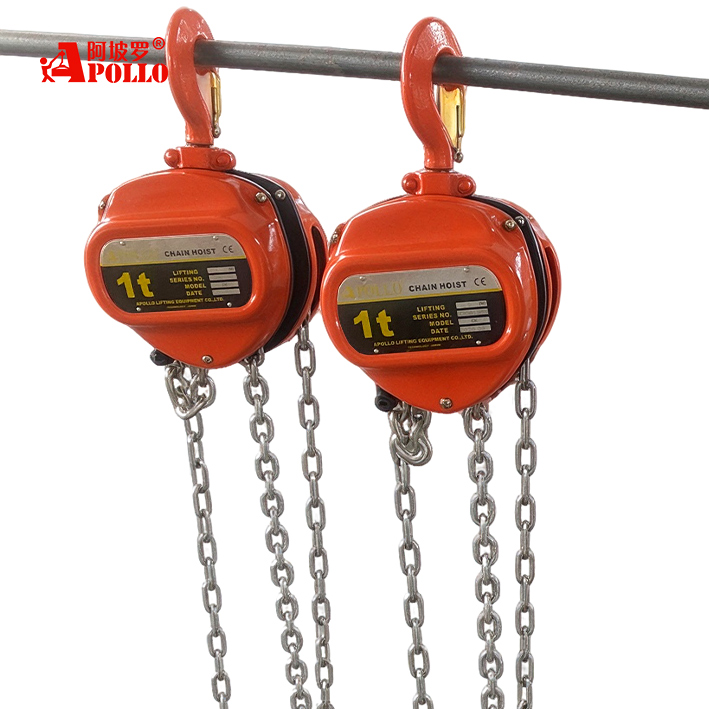
Most rigging crews pair the tool with an Apollo hand chain hoist (https://www.apollohoist.com/product-category/manual-hoist/chain-hoist/) for vertical work, and the inspection routine for the two tools overlaps enough to share one record sheet. For the applications where the Apollo lever hoist reaches what an overhead lift cannot, see how Apollo lever hoists work in confined spaces (https://www.apollohoist.com/product-news/confined-space-rigging-how-apollo-lever-hoists-solve-it-apollo-lifting-equipment-manufacturer/).
How to buy from Apollo: choose your channel
Plant, shutdown and project procurement
Get a free load assessment: send the capacity range, the application, and the inspection regime your site follows. Within one business day you receive a matched Apollo lever hoist recommendation, a wear-part list, a formal quotation and the conformity documents your inspection team needs.
Distributors and dealers
The 0.75 tonne to 9 tonne range ships under a single documentation package, so a distributor can support a contractor fleet with one parts list and one inspection procedure. Combining Apollo lever hoists, Apollo hand chain hoists and Apollo beam trolleys in one order protects margin and simplifies the customer’s spares holding.
OEM and private label
Custom branding, packaging and documentation are produced at the Apollo factory, built to the compliance requirements of your market.
Request conformity document samples now
- Get a free load assessment via WhatsApp / Phone: +86 18989488615
- Request conformity document samples by email: sales@apollohoist.com
- Submit an online inquiry: https://www.apollohoist.com/contact-us/
- Browse the full product range: https://www.apollohoist.com