The Trolley That Cannot Be Pushed
A workshop needs to move a 20-ton load sideways along an overhead beam. The crew fits a plain push trolley, and two workers heave on the load to get it rolling. The trolley creeps, the wheels squeal, and on a sloped or dirty beam it stalls completely. Forcing a heavy load on a push trolley is how wheels bind and loads swing out of control. The trolley is not faulty. It is undersized for the job – and push is the wrong drive for 20 tons.
An geared trolley changes the economics of moving heavy loads on an I-beam. The choice affects how much force your crew applies, whether the Apollo trolley fits your beam, and whether a 20-ton load stays under control. Get it wrong and the cost shows up in four places:
Push limits. A push trolley relies on the operator shoving the load. Above a few tons, that force is unsafe and impractical.
Beam mismatch. A trolley must match the flange width and profile of your I-beam; the wrong fit binds or walks off the flange.
Stability. A heavy load on a narrow wheel base can tip or derail on an uneven beam.
Overload risk. 20 tons on a beam not checked for capacity is a structural risk, not just a wheel problem.
This manual will provide useful information for plant managers, maintenance supervisors, and procurement officers dealing with overhead beams for movement of bulky equipment. This guide will provide you with the knowledge about an Apollo geared trolley, how to configure it for a 20-ton I-beam application and the design characteristics which differentiate a good Apollo trolley from a bad one.
Get a free load assessment: send your beam profile, span, and load weight to sales@apollohoist.com, and receive a matched Apollo trolley recommendation within one business day.
What an Apollo Geared Trolley Does Differently
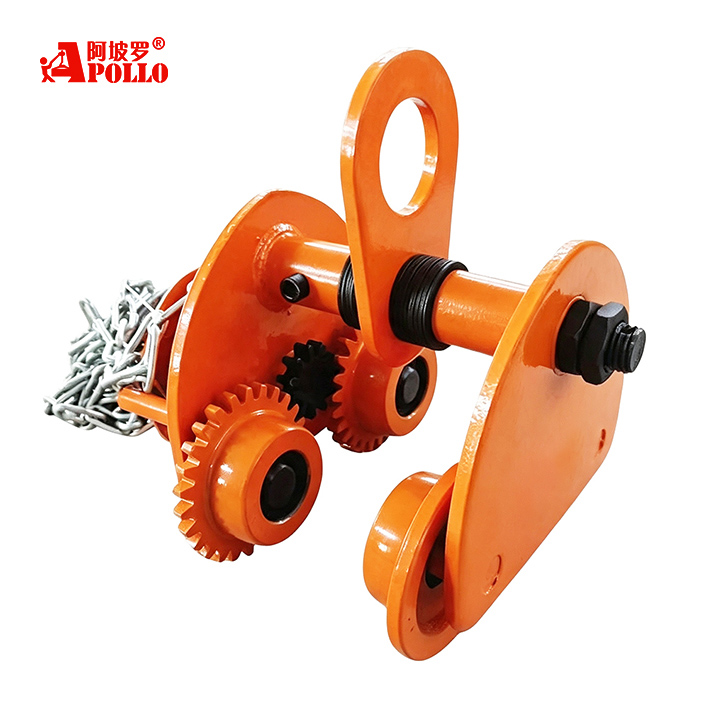
An Apollo trolley rides on the bottom flange of an I-beam and lets you move a suspended load along the beam. An Apollo plain push trolley is moved by the operator pushing the load directly. An Apollo geared trolley is driven by an endless hand chain that turns a gear train on the wheels, so the operator stands clear and moves the load with a steady pull instead of a shove.
The mechanical advantage is the point. On a 20-ton load, the force needed to start and stop a push trolley is beyond what one or two workers should apply. An Apollo geared trolley converts a moderate hand-chain pull into enough traction to move the load smoothly, and it holds position when you stop pulling, so the load does not run away on a slope.
Quick decision guide
Use an Apollo plain push trolley below about 2 tons on level, clean beams. Choose an Apollo geared trolley from 2 to 5 tons where effort and control matter, and treat it as the standard choice above 5 tons and at 20 tons, where hand-chain drive is the only safe way to start, stop, and hold a heavy load on an I-beam.
How to Match an Apollo Geared Trolley to a 20-Ton I-Beam Job
Verify the beam before anything else
A 20-ton trolley is only as safe as the beam it rides on. Confirm the beam section, span, and support structure can carry the combined weight of the load and the Apollo hoist, with the manufacturer’s rated working load. Ask for the beam capacity check in writing before you commit. A trolley that fits the flange is still unsafe if the beam is undersized.
Match the flange width range
Each Apollo trolley is built for a range of I-beam flange widths. Measure the actual flange width and edge profile of your beam, and choose an Apollo trolley whose adjustment range covers it. A trolley that is too narrow binds; one that is too wide sits loose and can walk off the flange. Confirm the wheel spacing and frame clearance for your beam height.
Choose the drive for the weight
Below about 2 tons, an Apollo push trolley is fine. From 2 to 5 tons, an Apollo geared trolley saves effort and improves control. Above 5 tons, and certainly at 20 tons, an Apollo geared trolley is the standard choice – the hand chain gives you traction to start and stop the load and control on slopes. Match the Apollo trolley’s working load limit to the full suspended weight, never below it.
Plan the pairing with the Apollo hoist
On a 20-ton beam, the Apollo trolley usually carries an Apollo chain hoist or Apollo electric hoist on the same suspension. Confirm the combined hook path and the Apollo trolley’s mounting interface for your Apollo hoist, and check the total height so the load clears the floor at full lift. Order the Apollo trolley and Apollo hoist as a matched set to avoid clearance surprises.
Installation checks matter as much as selection. When the Apollo trolley arrives, verify the wheel base adjustment against your measured flange width before the first load, and confirm end stops are fitted to the beam so the Apollo trolley cannot run off the end. A dry run with a light load checks tracking and braking before you commit a 20-ton lift.
Get a free load assessment: send your beam profile, span, and load weight via the inquiry page, and Apollo’s engineers will confirm the right Apollo trolley and email test samples at no cost.
What Separates a Quality Apollo Geared Trolley from a Cheap One
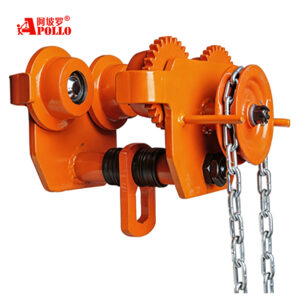
Nearly every heavy duty lifting equipment manufacturer can show EN certification and CE marking for the European market. Certification is the entry ticket, not the differentiator. What separates an Apollo trolley that still rolls true in year ten from one that binds in month six is how the certified design is built:
Forged wheels. Heat-treated wheel rims resist flat spots and edge wear under heavy repeated travel.
Sealed gearbox. A sealed, lubricated drive keeps dust and grit out of the gears, the main cause of stiff operation.
Adjustable wheel base. The frame adapts to your beam width and height so the Apollo trolley tracks straight and stays square to the flange.
Per-unit testing. Every Apollo trolley is load-tested at 125 percent of rated capacity before shipment, with records available per order.
Low-profile frame. A compact body keeps headroom loss small, so the load sits as high as possible under the beam.
Certification package. Confirm EN compliance and CE marking in writing, and ask for the test record serial number matched to your unit.
A 20-ton load also needs even distribution across the wheel base. Off-centre loading puts extra force on one wheel and one side of the beam, accelerating wear and risking derailment. Keep the suspension point centred under the Apollo trolley, and use a matched twin suspension where the load geometry demands it. Confirm the hook path and check the beam height in a trial travel before the first production move.
An Apollo geared trolley earns its keep when it is maintained. Wipe the beam flange clean before each move, because dirt and scale under the wheels increase rolling resistance and wear. Lubricate the wheel bearings and gearbox at the manufacturer’s interval, and check the wheel rims for flat spots or edge wear. Confirm the wheel base lock is tight so the Apollo trolley cannot drift along the flange. A monthly 15-minute check keeps a 20-ton Apollo trolley rolling true and catches problems before they become a dropped load.
Installation and Inspection Checklist
A trolley earns its keep only when it is installed and checked correctly. Run through this checklist before first use and on a monthly basis.
Verify the beam. Confirm the I-beam flange width, section, and span are within the trolley’s rated range and that the beam is certified for the full suspended load before anything is hung on it.
Set the wheel base. Adjust the wheel spacing to the measured flange width and lock the adjustment firmly. A loose wheel base walks off the flange under load.
Fit end stops. Confirm end stops are installed at both beam ends so the trolley cannot run off the track, and check the stops are rated for the trolley weight.
Dry-run with a light load. Move the empty or lightly loaded trolley the full travel before the first production lift to confirm smooth tracking, braking, and clearance.
Inspect wheels and drive. Check wheel rims for flat spots or edge wear, lubricate bearings and the gearbox at the manufacturer’s interval, and confirm all locks stay tight.
Apollo has manufactured lifting equipment for over 20 years, exporting to more than 50 countries, with factory-direct production and OEM support. See the full product range at https://www.apollohoist.com/product/.
How to Buy from Apollo: Choose Your Channel
Project procurement and site teams
Get a free load assessment: tell us your beam profile, span, and load weight. Within one business day you will receive a matched Apollo trolley recommendation, a formal quotation, and the test documents your safety officer needs.
Distributors and dealers
Stock the full Apollo trolley range under one certification package, with multi-product quotes that combine Apollo trolleys with Apollo chain hoists and Apollo lever hoists. Factory-direct pricing protects your margin.
OEM and private label
Custom branding, packaging, and documentation are available from the Apollo factory, built to your market’s compliance requirements.
Request EN Certificate Samples Now
Get a free load assessment via WhatsApp / Phone: +86 18989488615
Request EN certificate samples by email: sales@apollohoist.com
Submit an online inquiry: https://www.apollohoist.com/contact-us/
Browse the full product range: https://www.apollohoist.com