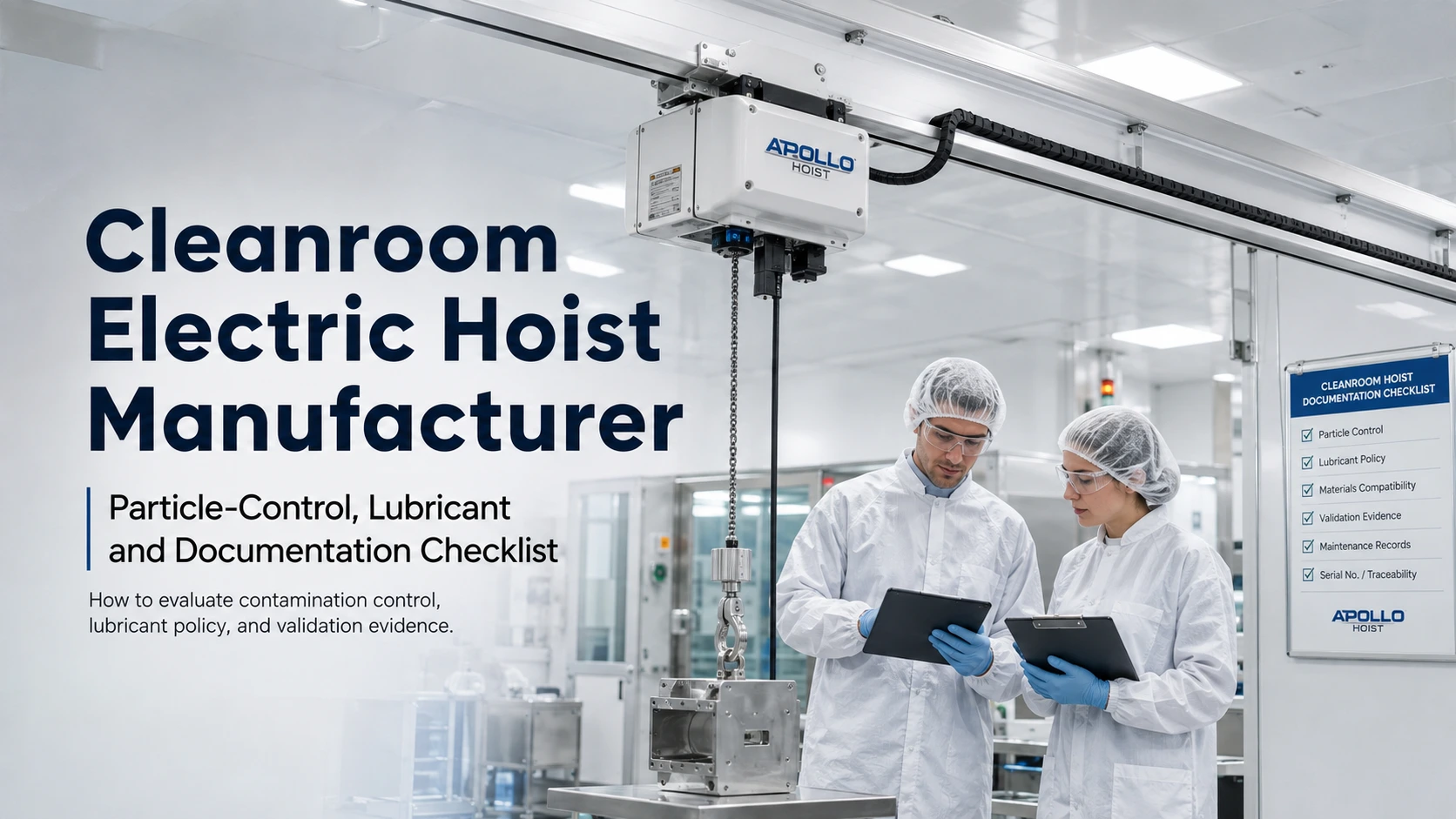
Choosing a cleanroom electric hoist manufacturer requires more than checking rated load and lift height. The hoist can become a contamination source through exposed lubricant, shedding finishes, unsealed cable entries, difficult-to-clean surfaces, or incomplete maintenance records. A credible RFQ therefore defines the cleanroom classification, particle-control objective, lubricant policy, cleaning method, and evidence package before a supplier quotes.
This checklist is written for pharmaceutical, semiconductor, medical-device, and other controlled environments. It helps facility engineers and procurement teams separate cleanroom suitability from generic “stainless” or “low dust” language, then request a documented configuration that can be reviewed by quality, engineering, and validation stakeholders.
Start with the cleanroom requirement, not the hoist label
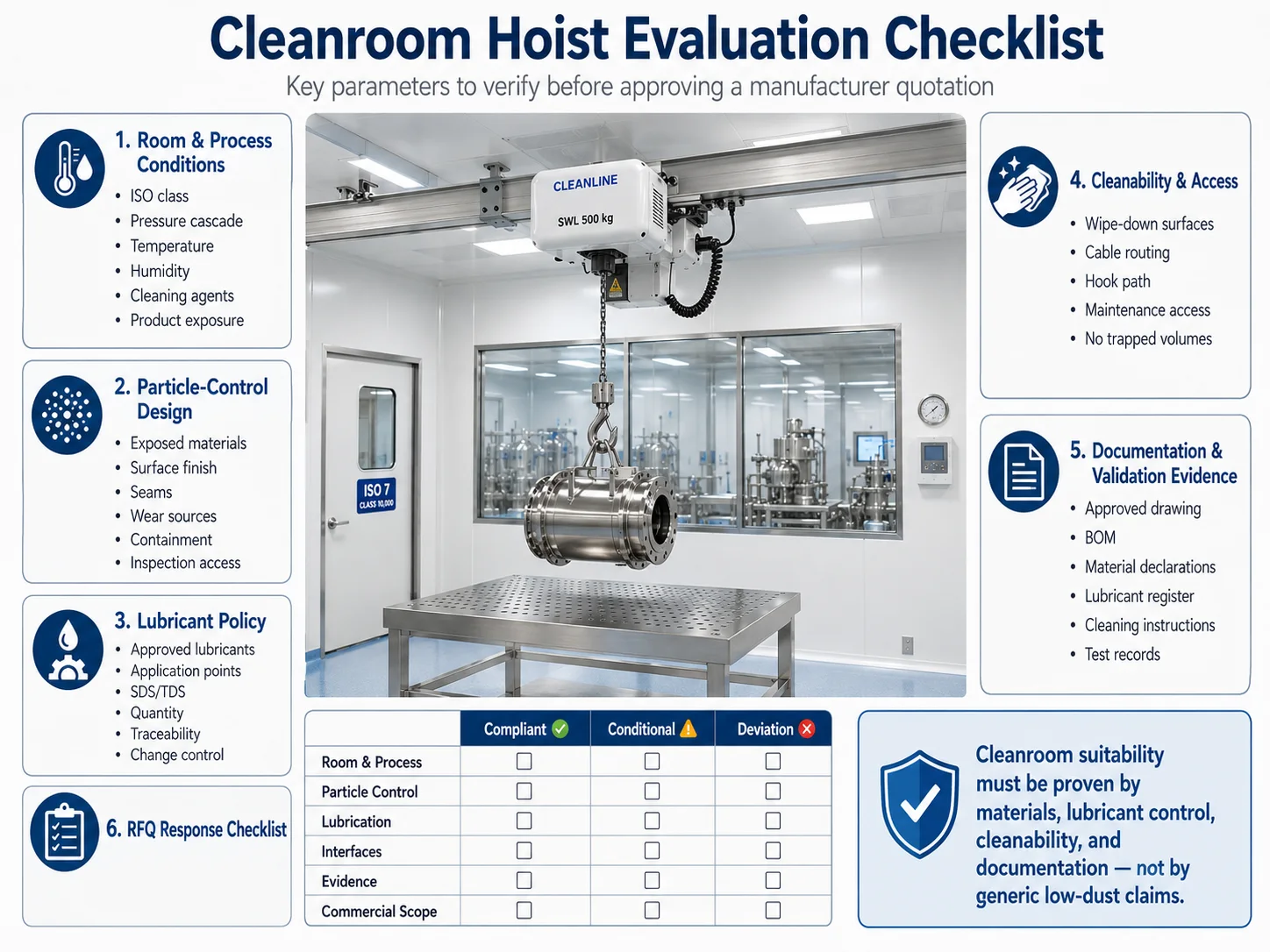
A cleanroom hoist must be selected for the room and process it serves. State the required ISO 14644 classification or the site standard, operating state, temperature, humidity, pressure cascade, cleaning agents, and whether the hoist enters the classified zone or operates above it. Identify the product exposure risk: a maintenance lift over an enclosed process is different from a hoist that handles open product containers.
Define the contamination concern in measurable terms. The RFQ may need particle limits, non-viable or viable monitoring expectations, outgassing restrictions, cleanability criteria, and a maximum allowable residue after cleaning. If the project uses a contamination-control strategy or validation protocol, reference the relevant requirement and assign approval ownership. Do not accept cleanroom as an unqualified product description.
Particle-control checklist for the hoist design
Materials, finishes, and shedding
Request a bill of materials for all surfaces exposed to the room: housing, rope drum, wire rope, hook block, trolley, guards, fasteners, labels, cable jackets, and protective covers. Ask the supplier to identify materials, surface treatments, coatings, and any particles or fibers that may be released during operation. Smooth, accessible surfaces are easier to wipe down, but the final material and finish still need compatibility review against the cleaning chemistry and process.
Avoid broad claims such as dust-proof or corrosion-resistant without a test or design definition. Ask where seams, ledges, threads, drain points, and trapped volumes occur. Require a marked drawing showing surfaces that cannot be accessed without disassembly. If a coating or seal is used, request its technical data and replacement method so maintenance does not introduce an unapproved material.
Movement, friction, and particle generation
Describe the motion profile and duty cycle because friction and braking events can affect particle generation. Include lifts per hour, starts and stops, speed changes, rope reeving, trolley travel, and the frequency of cleaning access. Ask whether the rope, sheaves, brake, gearbox, and trolley wheels are inside or outside the classified airflow. The supplier should explain how wear debris is contained and how inspection is performed without spreading contamination.
Seals, cable routing, and cleanability
List ingress-control expectations for motor housings, control boxes, connectors, pendant or remote-control equipment, and cable glands. A sealed enclosure may reduce ingress, but it can also make inspection and heat dissipation more difficult. Require an enclosure description, cable routing plan, and cleaning instructions. Confirm that the hook path, lower block, and any load interface can be wiped, visually inspected, and protected during room sanitization.
Lubricant and consumables policy
Lubricant selection is a process decision, not a catalog footnote. The RFQ should name the permitted lubricant family or approval standard, the locations requiring lubrication, the quantity and frequency, and the consequences of a missed or excessive application. Ask for the safety data sheet, technical data sheet, lot or batch traceability, and a statement about volatile components or residue where those factors matter to the process.
Separate factory-applied lubricant from field-applied maintenance products. State whether the hoist may be re-lubricated inside the classified room, whether a sealed-for-life component is acceptable, and how a lubricant change is controlled. Request a list of greases, oils, anti-seize products, thread lockers, hydraulic fluids, and corrosion inhibitors used anywhere on the supplied equipment. “Food grade” or “clean” is not a sufficient compatibility decision without process approval.
Documentation and validation evidence
A cleanroom-ready hoist should arrive with a traceable documentation package. Ask for:
- Model, serial number, approved configuration, revision-controlled drawing, and bill of materials.
- Material and finish declarations for exposed parts, including coatings, seals, cable jackets, and labels.
- Lubricant register with product names, locations, application quantities, safety data, and change-control notes.
- Cleaning and disinfection instructions, including prohibited chemicals, access limits, and re-lubrication steps.
- Particle-control or containment rationale, inspection points, maintenance intervals, and wear-part replacement criteria.
- Factory inspection and test records, calibration status for test equipment, and any requested certificates or declarations.
- Installation, commissioning, operator, maintenance, spare-parts, deviation, and nonconformance-report procedures.
Keep the document list tied to the actual serial-numbered configuration. A generic brochure cannot replace a material declaration, lubricant register, or approved cleaning method. Define which documents are required before shipment, at factory acceptance, and before site release.
Cleanroom electric hoist RFQ checklist
Use one response line per requirement and require the manufacturer to mark each item compliant, conditional, deviating, or not applicable. Include at least:
- Room and process: classification, pressure, temperature, humidity, airflow, cleaning agents, product exposure, and location of the hoist.
- Load and duty: rated load, fixture, center of gravity, lift, cycles per hour, speed, starts, stops, and service life.
- Particle control: exposed materials, finishes, seams, wear sources, containment, cleanability, and inspection access.
- Lubrication: approved products, application points, quantities, field-maintenance rules, SDS/TDS, and change control.
- Interfaces: power, controls, cable routing, emergency stops, guarding, access, and maintenance isolation.
- Evidence: drawings, BOM, declarations, cleaning method, test plan, inspection records, manuals, and spare parts.
- Commercial scope: packaging cleanliness, delivery condition, installation boundary, training, warranty, deviations, and document timing.

How to evaluate a cleanroom hoist manufacturer
Compare suppliers on evidence and lifecycle control, not only on the initial price. Check whether the proposed equipment is a standard configuration, a modified design, or a new development. Ask who approves materials and lubricants, who owns cleaning validation inputs, and how design changes are communicated after approval. Confirm that packaging, labeling, and spare parts will not introduce unreviewed materials into the controlled area.
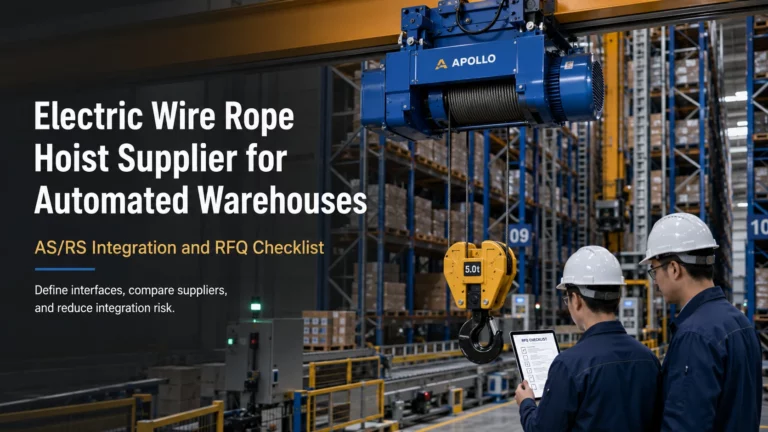
Apollo’s electric hoist category includes electric wire rope hoists and related electric-hoist families. Its ODM and OEM service page lists electric-hoist customization such as explosion-proof, dust-proof, rain-proof, frequency conversion, two-speed operation, voltage, surface treatment, and packaging. These are relevant RFQ discussion points, but the public pages do not establish a specific cleanroom class, particle test, lubricant approval, or validation package. Request those items in writing for the proposed configuration.
For a non-standard cleanroom requirement, Apollo’s R&D capabilities page can be included in the technical review. Ask for a responsibility matrix covering materials, lubricant selection, cleaning instructions, testing, document revisions, and site acceptance. Include the room classification, application, load, duty, cleaning chemistry, document list, quantity, and destination market in the technical inquiry.
Conclusion
A cleanroom electric hoist is acceptable only when its contamination risks and maintenance controls are understood. Define the room, process exposure, particle sources, materials, lubricant policy, cleaning method, interfaces, and evidence package in the RFQ. Then make the manufacturer prove how the exact configuration will be inspected, maintained, documented, and changed. That discipline gives quality and engineering teams a defensible basis for approval.
FAQs
Does dust-proof mean a hoist is suitable for a cleanroom?
No. Dust ingress protection addresses one design concern. Cleanroom suitability also depends on shedding, surface finish, lubricants, cleanability, maintenance access, and documented process requirements.
Can a standard electric wire rope hoist be used in a controlled environment?
Possibly, but only after the room classification, product exposure, materials, lubricant policy, cleaning method, and required evidence are reviewed and accepted by the responsible team.
What lubricant information should a supplier provide?
Request product names, safety and technical data sheets, application points, quantities, intervals, traceability, prohibited substitutes, and the process for approving any lubricant change.
Which documents are most important before shipment?
At minimum, obtain the approved drawing and BOM, material and finish declarations, lubricant register, cleaning instructions, inspection and test records, manuals, spare-parts list, and deviations register.
For a cleanroom hoist fit-check, contact Apollo with the room classification, load and duty profile, cleaning chemistry, exposure risk, required documents, quantity, and destination market.