1. The Hidden Cost of Moving Heavy Equipment
Every industrial facility manager knows the drill: a production line needs reconfiguring, a new CNC machine arrives, or a transformer must shift three meters to the left. The equipment weighs anywhere from 4 to 32 tons. The immediate question is not just “How do we move it?” but also “What will this do to the floor?”
Factory flooring is an expensive, engineered asset. An epoxy-coated industrial floor costs USD 5 to 15 per square foot to install. A single deep gouge from a steel-wheeled machinery skate can trigger a USD 10,000-plus repair bill — and that is before factoring in production downtime while the area is cordoned off for curing.
The problem is that many heavy duty lifting equipment users default to whatever moving tools are available, without evaluating whether those tools are compatible with their floor surface. This article provides a structured guide to selecting load-moving equipment that protects your facility’s flooring — while still getting the job done safely and efficiently.
By the end, you will understand the key technical factors that determine whether your equipment move leaves the floor intact or lands you in an unplanned facilities budget meeting. We will also introduce Apollo’s surface-safe approach and why the right lifting equipment supplier makes a measurable difference.
2. Seven Factors That Determine Floor Safety During Heavy Load Transfers
2.1 Ground Bearing Pressure: The Number That Predicts Floor Damage
Every wheel or contact pad exerts a downward force on the floor surface. The key metric is ground bearing pressure, expressed in N/mm² or MPa. When the pressure at any single contact point exceeds the floor’s compressive strength, damage occurs — cracks in concrete, gouges in epoxy, or compression marks in polished surfaces.
The formula is straightforward:
Pressure = Load (N) ÷ Contact Area (mm²)
Steel wheels, with their narrow contact profile, can generate bearing pressures of 50 N/mm² or more — easily exceeding the compressive strength of standard industrial concrete (typically 20–30 N/mm²) and far beyond what epoxy coatings can tolerate (5–15 N/mm²).
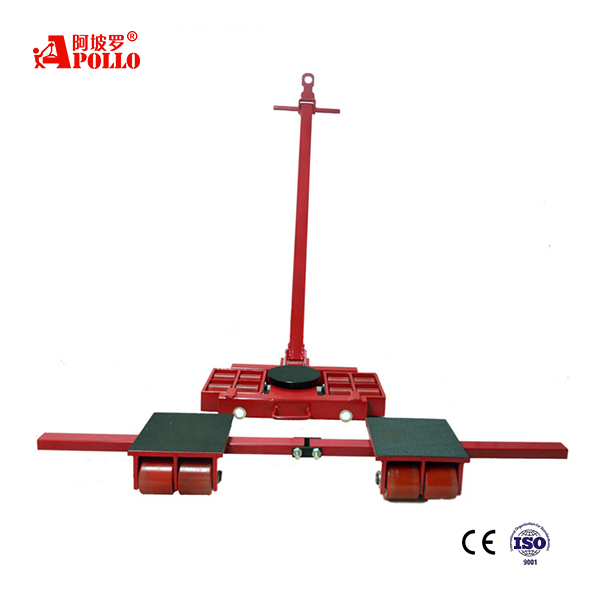
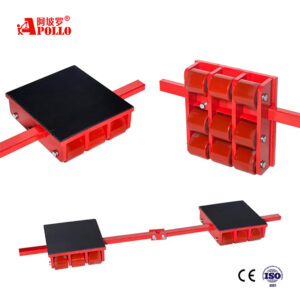
Apollo’s approach starts here: the Combined Handling Tank (X+Y) system uses polyurethane (PU) rollers across all models. PU wheels distribute load across a broader contact patch, typically keeping surface pressure below 15 N/mm² under rated loads. This alone reduces the risk of floor damage by an order of magnitude compared to steel-wheel alternatives.
2.2 Wheel Material: Not All Rollers Are Equal
The choice of wheel material directly affects three outcomes: floor protection, rolling resistance, and service life. Here is a practical comparison of the three most common materials in industrial lifting equipment:
| Wheel Material | Floor Protection | Durability | Typical Use Case |
| Steel | Poor — damages epoxy, concrete, polished surfaces | Excellent — nearly indestructible | Rail-guided or sacrificial floor environments |
| Nylon | Moderate — less aggressive than steel, but can still mark soft floors | Good — resistant to chemicals and impact | Wet or chemically active environments |
| Polyurethane (PU) | Excellent — non-marking, low contact pressure | Very good — wear-resistant with proper load distribution | Epoxy, polished concrete, tiled factory floors |
All Apollo Combined Handling Tank models come standard with Φ80×70mm PU rollers. For facilities with premium flooring (aerospace clean rooms, pharmaceutical plants, or high-gloss showroom floors), this specification eliminates a major source of facility damage risk from the outset.
2.3 Load Distribution: Why Wheel Count Matters More Than Capacity Rating
A 12-ton rated skate with 4 steel wheels will likely cause more floor damage than a 12-ton rated skate with 12 PU wheels — even if both are technically capable of carrying the load. The reason is simple: more contact points equal lower pressure per point.
The Apollo X+Y modular system scales from 4 to 32 wheels per unit, depending on the model selected. For example, the X12+Y12 configuration uses 24 wheels (12 on the front steering unit + 12 on the rear support pads) to distribute 12 tons of rated load. This design philosophy — more distribution points, not heavier individual wheels — is what separates surface-safe equipment from the rest.
When evaluating any heavy duty lifting equipment for floor-sensitive environments, count the wheels, not just the tonnage.
2.4 Steering Precision: Control Reduces Accidental Damage
Floor damage does not only come from static pressure. Sudden directional changes, uncontrolled pivoting, and jerky repositioning can concentrate force at a single point and scrape or gouge the surface. Precise steering is therefore a floor-protection feature — not just an operator convenience.
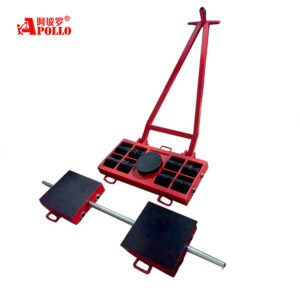
Apollo’s front steering unit (X section) incorporates an integrated 360° turntable bearing that allows operators to rotate the load smoothly in place, without the lurching or dragging that occurs with fixed-direction skates. The adjustable handle length (800 to 1,400 mm) gives operators the leverage needed for controlled, incremental repositioning — even in tight factory aisles.
2.5 Ergonomics: Operator Fatigue Leads to Mistakes
When a load-moving system is physically difficult to operate, quality control for the floor goes out the window. A tired operator rushing to finish a shift is more likely to misjudge clearance, clip a column base, or drag a pad across the floor instead of lifting and rolling properly.
Key ergonomic considerations include: compact overall height (Apollo X+Y units range from 110 to 140 mm, enabling low-clearance insertion without additional jacking), balanced handle leverage, and intuitive steering response. These factors may seem secondary to load capacity, but in practice, they determine whether the equipment is used correctly every single time.
2.6 Certification and Build Quality
Industrial lifting equipment operates under high-stakes conditions. A structural failure during a load transfer can cause injuries, equipment damage, and floor destruction simultaneously. Certification provides independent verification that the equipment meets recognised safety and manufacturing standards.
Apollo manufactures under ISO 9001 quality management systems, with products carrying CE and GS certifications. These are not marketing badges — they are audit-backed guarantees that every weld, every roller assembly, and every load-bearing component has been produced to verifiable, repeatable standards.
2.7 Total Cost of Ownership: Factor in Floor Repair
A purchasing decision based purely on equipment price tag is incomplete. The true cost of owning load-moving equipment includes floor maintenance, repair, and downtime. A USD 500 savings on a cheaper steel-wheeled skate can easily cost USD 8,000 in epoxy floor repair six months later.
When evaluating proposals from any lifting equipment supplier, ask for the wheel material specification, the contact pressure calculation at rated load, and the replacement cost of wear components. An honest supplier will provide these numbers without hesitation. An honest calculation will almost always favor surface-safe equipment for any facility with finished flooring.
3. Beyond the Product: Why Your Lifting Equipment Supplier Matters
Selecting the right equipment is only half the equation. The other half is selecting a supplier who can consistently deliver that equipment, support it over time, and provide the technical guidance that prevents costly mistakes before they happen.
3.1 The Risk of Unreliable Supply
In the industrial equipment trade, supplier inconsistency manifests in several ways: variable quality between batches, undocumented design changes, disappearing after-sales support, and certification paperwork that does not survive a regulatory audit. For a procurement manager, these risks translate into operational disruptions, compliance exposure, and reputational damage with their own customers.
3.2 The Apollo Manufacturing Advantage
Apollo brings over two decades of manufacturing experience to the heavy duty lifting equipment market. Key facts that matter to a procurement decision:
- 20+ yearsof focused manufacturing experience in lifting and material handling equipment.
- ISO 9001, CE, and GS certified— all three certifications are current audit-backed, not legacy claims.
- Exports to 50+ countries— the logistics team understands international shipping documentation, customs clearance, and regional compliance requirements.
- Factory-direct model— no intermediary markups. Buyers communicate directly with the engineering and production team that builds their equipment.
- OEM customization— if your application requires a non-standard wheel configuration, an extended handle, or a custom load pad dimension, Apollo’s in-house engineering team can design and deliver it.
- Rigorous quality control— every Combined Handling Tank unit undergoes load testing and dimensional inspection before shipment.
These are not marketing claims. They are operational facts that directly reduce a buyer’s total procurement risk — from order placement to after-sales support.
4. A Systematic Approach to Surface-Safe Heavy Load Handling
Protecting your facility’s flooring during heavy equipment transfers comes down to three decisions:
- Choose equipment with floor-compatible wheel materials. PU rollers over steel, every time, for finished factory floors.
- Prioritize load distribution over raw capacity. More contact points equal lower pressure per point.
- Select a supplier with verifiable certifications, consistent manufacturing quality, and responsive technical support — not just the lowest quote.
The Apollo Combined Handling Tank (X+Y) series is engineered specifically for industrial buyers who need to move heavy loads without leaving behind a repair bill. With models spanning 4 to 32 tons, modular X+Y configuration, 360° steering precision, and standard PU rollers, it represents a surface-safe approach to a problem that too many facilities accept as inevitable.
4.1 Start a Conversation with Apollo
Every facility layout is different. Every load configuration is unique. The best way to confirm that your equipment selection is correct is to discuss your specific application with an engineer who knows the product.
Contact Apollo today for a technical consultation, a quotation, or to request detailed specification sheets:
- WhatsApp: +86 18989488615
- Phone: +86 18989488615
- Email: sales@apollohoist.com
- Inquiry Form: apollohoist.com/contact-us/
Your floors are worth more than a gamble on the wrong equipment. Choose surface-safe. Choose Apollo.