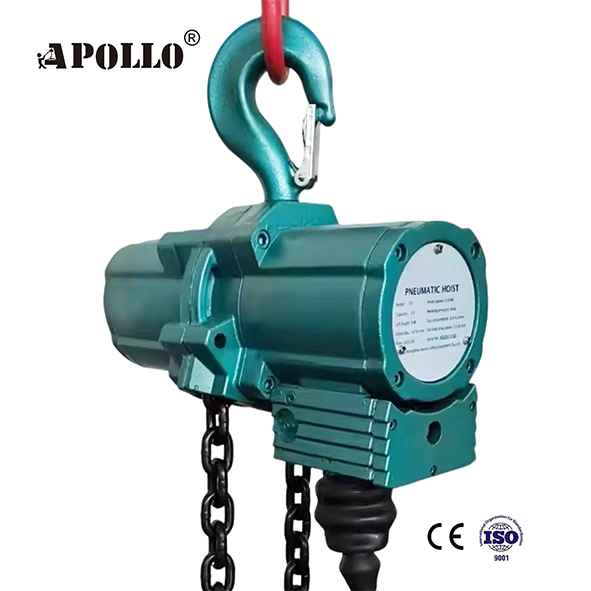
Introduction: Safety Meets Productivity in Industrial Material Handling
Choosing the right lifting equipment in industry is always not only related to its capacity. For procurement specialists and distributors working with chemical plants, refineries, facilities manufacturing paints and similar explosive industries, an improper selection may result in accidents, lack of compliance, unplanned stoppages and expensive changes. Heavy duty lifting equipment which operates successfully in a conventional warehouse can break completely if placed into a working area with flammable gases, dust or excessive heat.
The present guide is developed especially for experts who need to have a proven approach in choosing industrial lifting equipment for hazardous locations. If you are buying such equipment for your company or specifying solutions for your clients, knowledge of compliance issues, technical characteristics and supplier reliability will be extremely helpful. Being a proven provider of lifting equipment and having more than 20 years of working with the markets of hazardous industries, Apollo Lifting Devices has made the present guide following the questions asked by procurement specialists.
At the end of the article, you will find a ready-to-use checklist of pneumatic hoist solutions, guidelines of matching equipment according to your hazard location classification and criteria of choosing an ideal long-term partner-supplier of lifting equipment.
Six Critical Factors When Selecting Lifting Equipment for Hazardous Areas
1. Application Conditions and Hazardous Area Classification
The first and most important step is understanding exactly where the equipment will operate. Not all hazardous environments are created equal. International standards such as ATEX and IECEx classify gas hazard areas into three zones: Zone 0 (continuous explosive atmosphere), Zone 1 (explosive atmosphere likely during normal operation), and Zone 2 (unlikely and short-lived if it occurs).
For most industrial facilities — chemical processing, paint mixing, oil and gas downstream, pharmaceutical solvent handling — the relevant categories are Zone 1 and Zone 2. Electric hoists, which generate sparks through motors and contactors, are generally unsuitable for Zone 1 and require expensive explosion-proof modifications even for Zone 2. Pneumatic hoists, by contrast, operate on compressed air and produce no electrical arcing, making them the natural choice for these environments.
Apollo pneumatic hoists are engineered for Zone 1 and Zone 2 applications, with an explosion protection classification of II2GD IIC T4. This means they can be deployed across the vast majority of hazardous industrial settings without additional engineering work. Always confirm your site’s zone classification first, then match the equipment’s protection level accordingly — never assume a general-purpose unit will pass inspection.
2. Safe Working Load and Capacity Planning
Heavy duty lifting equipment must be selected with both current and future requirements in mind. Under-sizing leads to unsafe operation and premature wear; over-sizing wastes capital and compressed air energy. Procurement managers often focus only on the maximum single load, but duty cycle — how frequently the hoist lifts per hour — matters just as much for longevity.
Pneumatic hoists excel in high-cycle applications because they can run continuously without the thermal overload that plagues electric motors. When calculating capacity, consider not just the nominal load, but also whether you will be performing horizontal towing, frequent spot positioning, or continuous production-line lifts. These factors all influence the appropriate tonnage and model selection.
The Apollo MPROFI series covers a wide capacity range from 250 kg up to 100 tons, allowing facilities to standardize on a single product family across light-duty assembly stations and heavy industrial bays. Standardizing on one lifting equipment supplier simplifies spare parts inventory, operator training, and maintenance procedures across your entire operation.
3. Key Performance Metrics: Speed, Control, and Precision
Industrial lifting equipment is not just about moving weight — it is about moving it accurately and efficiently. In assembly operations, foundries, and precision manufacturing, the ability to position loads at micro-speeds directly impacts product quality and worker productivity. Jerky or imprecise lifting causes rework, damaged parts, and safety incidents.
Pneumatic hoists offer inherently variable speed control through simple air throttle adjustment. Skilled operators can feather the control for fine positioning or run at full speed for long vertical travels. This stepless speed variation is one of the most underappreciated advantages of pneumatic systems over basic electric chain hoists, which typically offer only two or three fixed speeds.
Apollo pneumatic hoists feature sensitive variable speed control as a standard feature, ensuring accurate positioning for both heavy objects and delicate assembly tasks. The instant response of the air motor means operators maintain full control throughout the lift, reducing cycle times while improving workplace safety.
4. Ergonomics and Operational Usability
Equipment that is difficult to operate does not get used correctly. Poor ergonomics lead to operator fatigue, slower workflows, and increased safety incidents. When evaluating industrial lifting equipment, consider the control interface, weight of the pendant, accessibility of maintenance points, and how the unit integrates with your existing trolley or monorail systems.
Pneumatic hoists are available with multiple control options: rope control, pneumatic pendant control, and electric control. Each has advantages depending on the environment. Rope control is simplest and fully spark-free; pneumatic pendants offer precise feathering; electric controls integrate with building automation systems but require additional explosion-proof certification for the control circuit.
As a flexible lifting equipment supplier, Apollo offers all three control configurations so you can match the interface to your operators’ preferences and site safety requirements. Compatibility with standard beam trolleys — both hand-push and motorized — means the hoist drops into existing material handling infrastructure without custom engineering.
5. Certifications and Compliance Documentation
Certification is compulsory in dangerous industries; it is a requirement. When procurement managers handle products such as heavy-duty lifting equipment, they have to be certain that the product has not only been given a CE mark but also has the right explosion-proof certification from a notified body. Failure to do this could stop a facility audit or worse still lead to liabilities after an accident.
The certificates one needs to check for are: ATEX or IECEx for explosion proofing, ISO 9001 for manufacturing quality management, GS for safety tests, and CE certification. In addition to having all these certificates, suppliers should have technical data packages, declarations of conformity, and component traceability records.
All the Apollo hoists are ISO 9001 quality management certified, CE certified and GS certified for industrial lifting equipment. All the pneumatic hoists are shipped with full compliance documentation making it easy for safety inspection audits and facility audits for end users and distributors serving many clients.
6. Maintenance Requirements and Total Cost of Ownership
Purchase price is only the first line item. The real cost of heavy duty lifting equipment appears over years of service: spare parts, maintenance labor, downtime during repairs, and eventual replacement. Procurement managers who evaluate only upfront cost often end up spending far more over the equipment’s lifecycle.
Pneumatic hoists generally have lower long-term maintenance costs than electric alternatives in harsh environments. There are no motor windings to burn out, no contactors to pit, and no electrical components to degrade in dusty or damp conditions. The planetary gear reduction system is robust and requires only periodic lubrication. Air supply filtration is the primary consumable, and filter replacements are quick and inexpensive.
Apollo pneumatic hoists are built with low-maintenance brake motors and high-quality alloy steel gear teeth, engineered for continuous duty in harsh industrial settings. The self-lubricating design reduces scheduled maintenance intervals, and the modular construction means repairs can be completed on-site without returning the unit to the factory. For distributors, this reliability translates to fewer warranty claims and stronger customer satisfaction over time.
Why Choosing the Right Lifting Equipment Supplier Matters as Much as the Product
Selecting industrial lifting equipment is not a one-time transaction — it is the beginning of a multi-year partnership. The supplier you choose determines whether you receive consistent quality, timely spare parts, technical support when problems arise, and adaptability as your operational needs evolve.
Working with an unverified supplier carries real risks. Quality inconsistencies between batches can create safety hazards. Long lead times on replacement parts translate directly into production downtime. Inadequate technical documentation can cause compliance failures during audits. And for distributors, a supplier that cannot reliably meet delivery schedules damages your reputation with your own customers.
Apollo brings more than 20 years of manufacturing experience as a dedicated lifting equipment supplier. Our products are exported to over 50 countries, supported by a rigorous quality control system certified under ISO 9001. Every unit undergoes testing before shipment, and our factory-direct model means you work directly with the engineering and production teams — no middlemen adding cost or communication delays.
For equipment distributors, we offer comprehensive OEM customization capabilities, allowing you to brand and configure pneumatic hoists to meet your specific market requirements. Our CE, GS, and ISO certifications provide the compliance foundation you need to serve regulated markets with confidence. Whether you need a single heavy duty lifting equipment unit for a special project or a steady supply for ongoing distribution, our production capacity and quality systems deliver consistency you can build a business around.
The best supplier relationships are built on transparency, engineering depth, and long-term reliability. Apollo is structured to support both end-user procurement teams and distribution partners with technical documentation, responsive communication, and manufacturing flexibility that larger, more bureaucratic manufacturers cannot match.
Your Next Step: Specify with Confidence
Selection of suitable equipment for hazardous zones entails considerations regarding safety, performance, and cost. The key points that would be discussed below include the need to determine your zone classification, evaluation of your lifting capacity needs, consideration of ergonomic and precision controls, obtaining certification, total cost of ownership analysis, and selection of a reliable supplier.
Apollo pneumatic hoist units have been designed with a particular focus on lifting equipment applications in hazardous zones. They are explosion protected and certified for Zone 1 and Zone 2, have a capacity range of 250 kg to 100 tons, and are produced by a company with 20-year experience and ISO 9001, CE, and GS certifications. Apollo lifting equipment may be recommended for use at chemical plants, oil and gas refineries, paint plants, foundries, and other places where explosive atmospheres may occur all over the world.
When selecting heavy duty lifting equipment for your future projects or looking for new suppliers for your distribution program, we are here to assist you.
Contact Apollo Today
Reach out through any of the following channels:
- WhatsApp: +86 18989488615
- Phone: +86 18989488615
- Email: sales@apollohoist.com
- Inquiry Form: https://www.apollohoist.com/contact-us/
Tell us about your hazardous area lifting requirements, and receive a personalized recommendation within one business day. As a direct-from-factory lifting equipment supplier, Apollo delivers both the engineering expertise and the commercial flexibility to support your project — whether you need one unit or a full fleet.