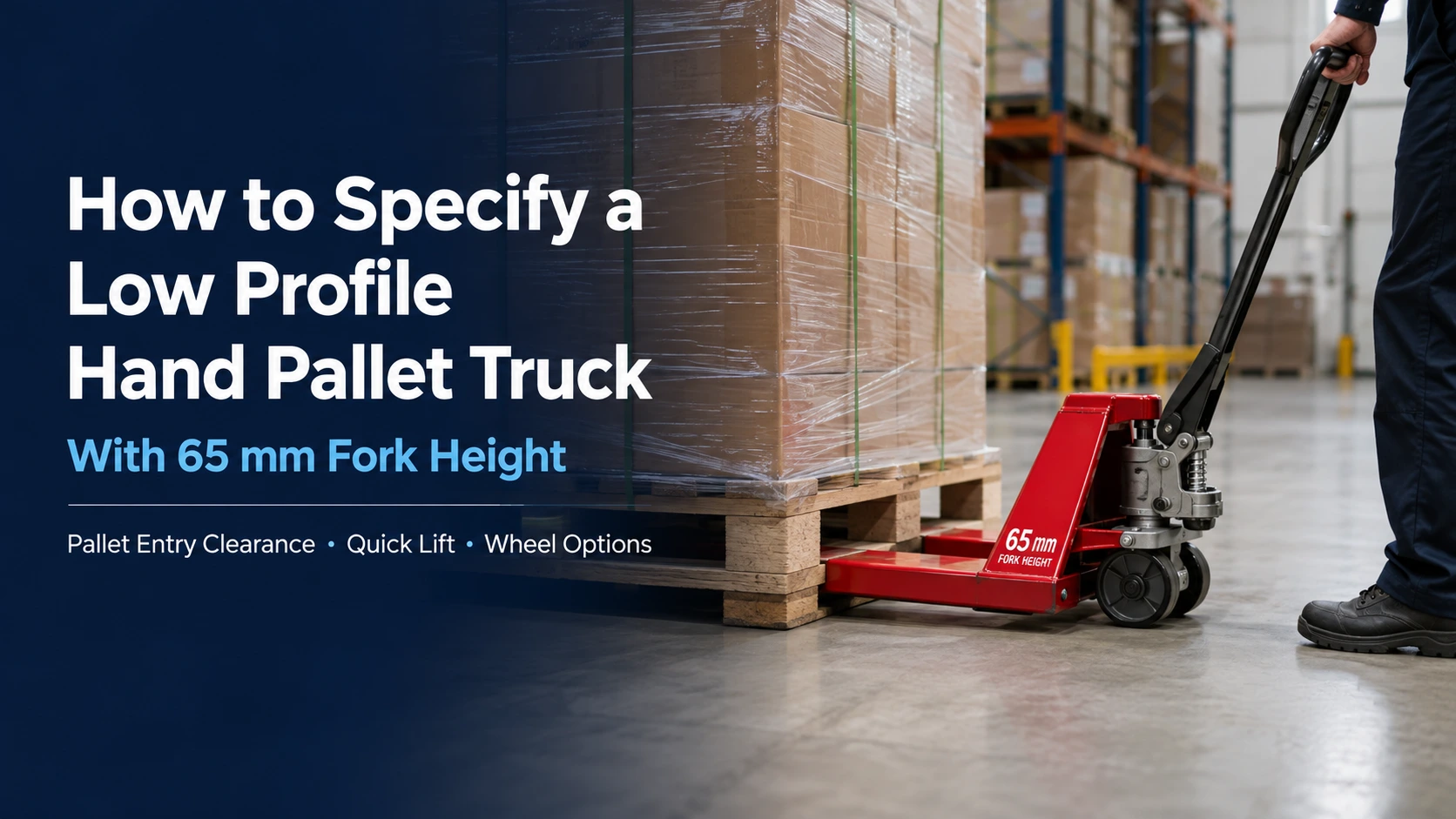
A low profile hand pallet truck is only useful when its forks can enter the pallets used at your site. A 65 mm lowered fork height can solve a genuine clearance problem, but it should not be treated as a universal upgrade. Warehouse buyers need to measure pallet openings, confirm the complete truck configuration, and test the route before approving an order from a China factory.
Apollo’s Kawasaki PT2 low-profile hand pallet truck is listed in 2,500 and 3,000 kg configurations with quick lift. Its published data includes paired values for lowered height, lifting height, width, length, turning radius, and wheel size. Those pairs make configuration control essential: the purchase order should identify the exact combination rather than mixing values from different versions.
Measure Pallet Entry Clearance Before Choosing 65 mm
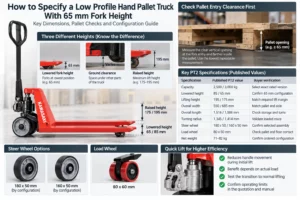
Start with the pallet, not the truck brochure. Measure the clear vertical opening where the fork tips enter, then repeat the measurement farther inside the pallet. Check several pallets from each supplier because worn deck boards, protruding fasteners, sagging loads, and repair blocks can reduce the usable opening. Record the lowest repeatable clearance, not the best sample.
Leave practical clearance for uneven floors and manufacturing variation. A nominal 65 mm opening does not guarantee that a 65 mm fork will enter freely. If the site uses more than one pallet type, build a pallet matrix that records opening height, entry width, stringer layout, underside obstructions, and load condition. Buyers should also confirm whether entry is required from two sides or four sides.
Do Not Confuse Three Different Heights
Lowered fork height describes the fork’s lowest position. Ground clearance describes the space beneath other parts of the truck, and raised height describes how high the forks can lift. These values answer different questions. A truck may enter a low pallet yet contact a threshold elsewhere on the route, or it may enter correctly but lack the required lift margin for a particular transfer.
Decode the PT2 Configuration Before Ordering
Apollo publishes the following PT2 figures. Where two values appear, require the supplier’s quotation and drawing to map each value to the selected capacity and fork configuration. Do not assume that the first number always belongs to one capacity.
| Specification | Published PT2 value | Buyer verification |
| Capacity | 2,500 / 3,000 kg | Select exact rated version |
| Lowered height | 85 / 65 mm | Confirm 65 mm configuration |
| Lifting height | 195 / 175 mm | Match required lift margin |
| Overall width | 550 / 685 mm | Match pallet and aisle |
| Overall length | 1,516 / 1,586 mm | Check storage and turns |
| Turning radius | 1,345 / 1,414 mm | Validate loaded route |
| Steer wheel | 180 x 50 / 160 x 50 mm | Confirm selected assembly |
| Load wheel | 80 x 60 mm | Check pallet and floor contact |
| Net weight | 71-82 kg | Confirm ordered configuration |
The published wheelbase is 1,242 or 1,312 mm, while tread width is 400 or 535 mm. These dimensions also require configuration-level confirmation. For alternate sizes or applications, review Apollo’s broader pallet truck range without assuming that specifications transfer from one model to another.
Treat Quick Lift as a Workflow Feature
Quick lift is most valuable during repeated pickup cycles because it can reduce the handle movement needed before the forks meet the pallet or load. Its benefit depends on how the pump behaves under the actual load. Ask the factory to demonstrate the transition from quick-lift behavior to normal lifting and to state any operating limits in the manual and quotation.
Do not approve the feature from the product name alone. During a sample test, count handle cycles for empty fork travel, initial contact, and the site’s representative load. Check controlled lowering and neutral operation as well. The result should be recorded against the tested unit and pallet so procurement can compare like with like without relying on an unverified stroke claim.
Specify Wheel Geometry and Material Separately
Diameter, Width, and Position
The PT2 page lists two steer-wheel sizes, 180 x 50 mm and 160 x 50 mm, plus an 80 x 60 mm load wheel. Wheel diameter affects obstacle negotiation and lowered geometry, while width and wheel placement affect contact pressure, rolling resistance, and pallet entry. Confirm which steer-wheel assembly belongs to the 65 mm version and whether any option changes the lowered height.
Wheel Material Is a Separate Purchase Decision
The published page does not identify wheel material, so request it explicitly. Describe the floor, debris exposure, noise limits, marking restrictions, temperature, moisture, and chemical contact. Ask for the proposed steer and load wheel materials, hardness or grade where applicable, part numbers, bearing details, and replacement availability. A generic promise of ‘wheel options’ is not enough for an approved bill of materials.
Check the Entire Travel Route
Low pallet clearance is only one constraint. Walk the loaded route and inspect joints, dock plates, drains, thresholds, ramps, floor damage, tight turns, and pedestrian areas. Compare the PT2’s listed 1,345 or 1,414 mm turning radius with the narrowest maneuver, then confirm the value for the ordered configuration. Allow room for the pallet and load overhang, not only the truck envelope.
Manual travel effort changes with load, wheel condition, floor resistance, and gradients. A nominal capacity rating does not prove that operators can move the load comfortably through every part of the route. Use a representative loaded trial and document any route where another handling method is required. Apollo’s overview of pallet truck ergonomics and warehouse efficiency provides complementary context for reviewing operator interaction.
Audit a China Factory Quotation
Lock the Specification to Documents
Request a model-specific quotation, dimensional drawing, data sheet, operating manual, spare-parts list, and configuration code. The documents should repeat the selected capacity, 65 mm lowered height, fork width and length, raised height, overall dimensions, wheel sizes and materials, net weight, and quick-lift description. Resolve inconsistent values before the order is released.
Define a Pre-Shipment Acceptance Check
Agree on measurable checks: nameplate and configuration match, lowered fork height, fork dimensions, wheel identification, unloaded operation, representative pallet entry, lift and controlled lowering, steering, visible finish, and document completeness. State the test load and pallet used. Photographs or video can support the record, but they should not replace agreed measurements or the buyer’s receiving inspection.
Send a Complete RFQ
Include the following inputs in the request for quotation:
- Maximum and typical load, load distribution, and pallet types with measured openings.
- Required fork length, overall fork width, 65 mm entry requirement, and target raised height.
- Moves per shift, travel distance, turning points, gradients, thresholds, and floor condition.
- Requested steer and load wheel materials, environmental constraints, and spare wheel quantities.
- Quick-lift verification method, required documents, inspection points, and receiving test.
When these inputs are ready, send them through Apollo’s contact page and ask the supplier to return a single, configuration-specific offer. This reduces the risk of approving capacity from one version, dimensions from another, and wheel details that were never formally confirmed.
Conclusion
A 65 mm low profile hand pallet truck should be selected through measurement and configuration control. Verify pallet entry, distinguish lowered height from ground clearance and raised height, map every paired PT2 value to the ordered version, test quick lift under defined conditions, and specify wheel geometry and material separately. A disciplined RFQ and acceptance test turn a low-profile claim into a truck that fits the pallets, route, and operating workflow.
Frequently Asked Questions
Is 65 mm fork height suitable for every pallet?
No. Measure the actual pallet openings and internal obstructions across representative samples. The nominal opening must also leave practical clearance for pallet variation and uneven floors.
Does the PT2 always have a 65 mm lowered height?
No. Apollo publishes paired 85 and 65 mm values. The quotation and drawing should explicitly identify the selected configuration and all dimensions associated with it.
How should buyers verify quick lift?
Ask for the operating description and test a sample with empty forks and a representative palletized load. Record handle cycles and the transition to normal lifting without assuming an advertised stroke count.
Which pallet jack wheel option is best?
There is no universal choice. Match wheel dimensions and material to pallet geometry, floor condition, debris, noise and marking limits, environment, and service requirements, then record the exact parts in the order.