The Fall Configuration Mistake That Slows Down Your Line
A production manager installs a new 2-ton electric chain hoist and discovers that every lift takes twice as long as the unit it replaced. The hoist is not faulty. The chain fall configuration is wrong for the job, and the mistake was made at the ordering desk, not on the line.
Fall configuration is one of the most misunderstood specs in overhead lifting, and the cost of getting it wrong shows up in four places:
- Cycle time.A double-fall hoist lifts at roughly half the speed of a single-fall unit. On a high-cadence line, that gap is lost output every single shift.
- Chain wear.A single-fall hoist carrying a heavy load puts full tension on one chain line. The chain is the main wear item, and premature wear means earlier replacement.
- Double-fall configurations need more headroom for the bottom block. In a low-ceiling facility, the hoist may not fit at all.
- A configuration mismatch is discovered on installation day, and the correction costs a stopped job and a return shipment.
- The financial impact is straightforward to model. A hoist cycling 30 times per hour at half speed loses roughly 90 seconds per cycle, which adds up to 45 minutes of lost production per shift. On a two-shift operation, that is 7.5 hours a week — nearly a full operator shift paid for output that never arrives. Chain replacement on a mismatched single-fall unit can occur at 18 months instead of the rated 36, doubling the consumable cost over the hoist’s service life.
This guide is for production managers, maintenance supervisors, and procurement teams selecting electric lifting equipment. It explains what single fall and double fall actually change, how to match the configuration to your workflow, and the specs that separate a hoist that runs for years from one that fails early.
Get a free load assessment: send your load weight, lift height, and cycle time to sales@apollohoist.com, and receive a matched hoist recommendation within one business day.
Single Fall vs Double Fall: What’s the Difference?
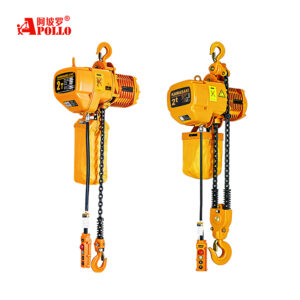
In a single-fall hoist, the load chain runs in one line from the hook to the chain bucket, and the full load rides on that single chain line. In a double-fall hoist, the chain loops through a bottom block so two chain lines share the load. More chain lines mean slower lift speed and lower load per chain link.
The speed relationship is mechanical, not arbitrary. In a double-fall setup, the motor must pull twice the chain length to move the load the same vertical distance, so lift speed is approximately halved while the working load per chain link is also halved. This is why a 2-ton double-fall hoist uses the same chain size as a 1-ton single-fall unit. For buyers, this means the same hoist body can often be configured either way — the difference is the bottom block and chain routing, not the motor. Confirm with your supplier whether a field conversion is possible if your workflow changes after installation.
| Factor | Single fall | Double fall |
| Lift speed | Faster, up to about 7 m/min on light models | Slower, roughly half the single-fall speed |
| Load per chain line | Full load on one chain | Load shared across two chain lines |
| Chain wear | Faster under heavy continuous load | More even, longer chain life |
| Headroom | Lower, fits tighter ceilings | Higher, needs room for the bottom block |
| Best suited to | High-cycle, light-to-medium loads | Heavy loads, low-cycle maintenance duty |
Neither configuration is better. Each one is matched to a different workflow, and the match is the whole point of the choice.
How to Match Fall Configuration to Your Workflow
High-cycle, light-load production lines
If the hoist cycles dozens of times per hour moving light-to-medium loads, speed is the throughput driver. A single-fall configuration with a dual-speed travel motor (fast positioning plus a creep speed for fine placement) keeps the line moving without sacrificing control.
Typical applications include assembly line feeders, injection molding machine loading, and order-picking stations in distribution centers. In these environments, a 2 FPM (feet per minute) speed difference between single and double fall translates to measurable throughput loss over a full shift. Dual-speed hoists with variable frequency drives offer the best compromise, allowing fast travel and controlled descent for precision placement.
Heavy-load, low-cycle maintenance duty
If the hoist moves heavy components a few times per day, lift speed barely matters and chain life does. A double-fall configuration spreads the load across two chain lines, which slows the lift but extends the interval between chain replacements on a unit that is expensive to take out of service.
These are typically found in die shops, heavy equipment maintenance bays, and mining equipment repair facilities. The hoist may sit idle for days and then perform a single critical lift that positions a 10-ton gearbox. In this context, the extra 30 seconds per lift is irrelevant, but a chain failure during the lift is catastrophic. Double fall provides the safety margin these operations require, and the reduced chain tension also lowers stress on the hook, shackle, and bottom block bearings.
Low-headroom facilities
Headroom is a hard constraint, not a preference. Measure the distance from the beam underside to the floor and confirm the hoist headroom fits before you order. A double-fall unit that needs more headroom than the building has is a specification that cannot be negotiated on site.
Low-headroom electric chain hoists are available with reduced body heights, but even these models gain or lose a few inches depending on fall configuration. Always request the dimensional drawing for the exact configuration you plan to order, not a generic product sheet. A drawing that shows single-fall dimensions will not tell you whether the double-fall bottom block clears your overhead obstructions.
Get a free load assessment: send your load weight, lift height, and cycle time via the inquiry page, and Apollo’s engineers will confirm the right fall configuration and email test samples at no cost.
What Separates a Quality Electric Hoist from a Cheap One
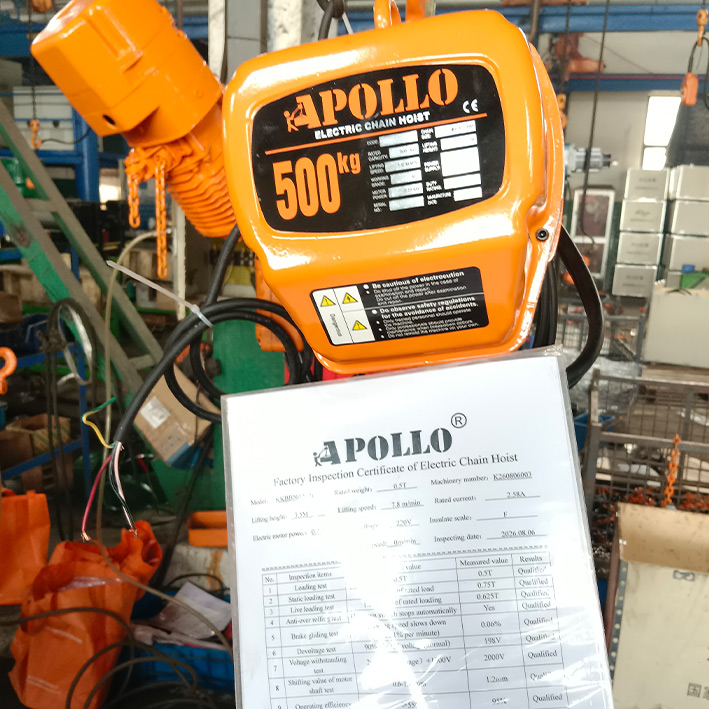
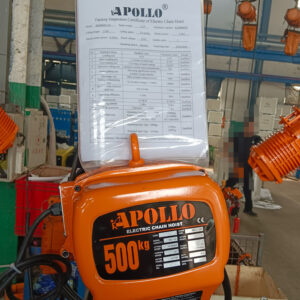
Nearly every heavy duty lifting equipment manufacturer can show certification documents. The entry ticket is verifiable testing: every Apollo electric chain hoist is load-tested at 125 percent of rated capacity before shipment. What separates units that run for years from early failures is how the certified design is built:
- Global voltage range.200-460V at 50/60Hz covers the world’s major industrial power standards without voltage-specific sub-models or external transformers.
- Dual-speed travel.A travel motor with high and low speeds gives fast positioning for long moves and a creep speed for fine placement.
- Integrated motorized trolley.Lifting and horizontal travel are both powered in one unit, replacing a separate hoist and push trolley combination.
- Compact headroom.Motorized models with headroom comparable to manual setups bring automation into facilities never designed for it.
- Per-unit load testing.125 percent test load on every unit, documented and available with the order.
- Thermal motor protection. Hoist motors that run continuously in high-cycle applications need built-in thermal sensors that cut power before the winding insulation degrades. Budget models rely on external breakers that trip only after damage has begun.
- Chain guide design. A precision-machined chain guide prevents chain jumping and cross-linking during fast lifts, the single most common cause of sudden chain failure on production floors. Pressed or stamped guides wear quickly and allow the chain to ride at an angle.
Two specs buyers often forget: voltage tolerance and duty. Confirm the hoist input matches your facility power, and confirm the duty rating matches your usage. A hoist rated for intermittent use will fail quickly in an eight-hour production environment, regardless of its fall configuration.
Common Misconceptions About Fall Configuration
Three beliefs cause most ordering errors. First, that double fall is always safer — it is safer per chain link but introduces a bottom block that can swing and requires more headroom. Second, that single fall is always faster — at very high capacities, a single-fall chain becomes so large that the motor must slow down anyway, erasing the speed advantage. Third, that the choice is permanent — many hoist models support field conversion between single and double fall, but the conversion requires a qualified technician and must be verified by a 125 percent load test before returning to service.
Three Questions to Ask Any Supplier
Any electric chain hoist manufacturer and supplier should answer these three before you order:
- Can you send the load test and certification documents before I order?Apollo ships test records with each order and shares samples on request.
- What chain does the hoist use, and how long is the replacement interval?Chain metallurgy and fall configuration both drive wear; Apollo specifies the chain and stocks spares for the full range.
- How do you confirm voltage, headroom, and beam width compatibility?Send your facility power, ceiling height, and beam profile, and Apollo confirms fit before you commit.
Apollo has manufactured lifting equipment for over 20 years, exporting to more than 50 countries, with factory-direct production and OEM support.
How to Buy from Apollo: Choose Your Channel
Project procurement and site teams
Get a free load assessment: tell us your load weight, lift height, cycle time, and facility power. Within one business day you will receive a matched hoist configuration recommendation, a formal quotation, and the test documents your safety officer needs.
Distributors and dealers
Stock the full electric hoist range under one certification package, with multi-product quotes that combine electric hoists with chain hoists and trolleys. Factory-direct pricing protects your margin.
OEM and private label
Custom branding, packaging, and documentation are available from the Apollo factory, built to your market’s compliance requirements.
Request EN Certificate Samples Now
- Get a free load assessment via WhatsApp / Phone: +86 18989488615
- Request EN certificate samples by email: sales@apollohoist.com
- Submit an online inquiry: https://www.apollohoist.com/contact-us/
- Browse the full product range: https://www.apollohoist.com