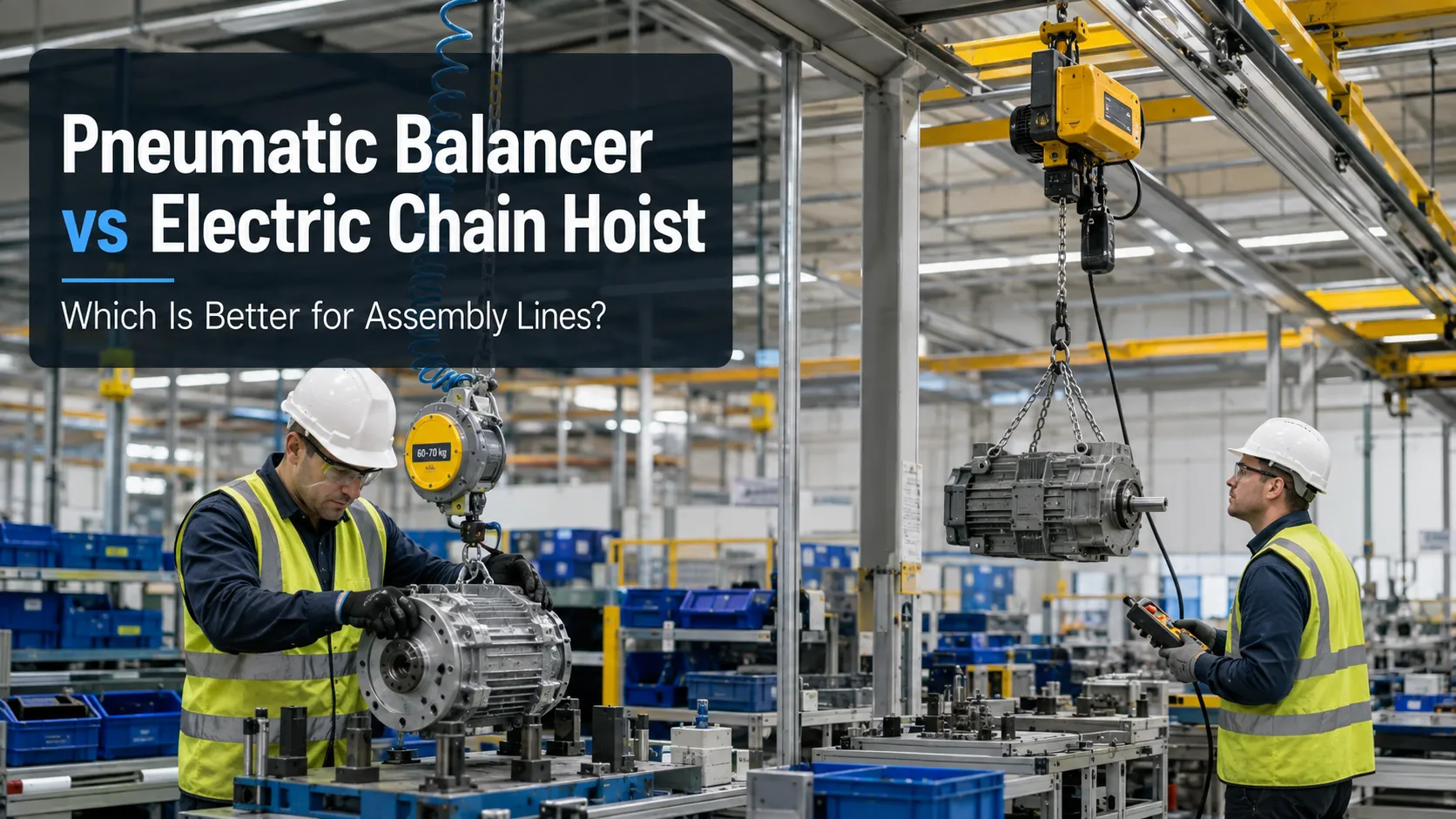
Choosing between a pneumatic balancer vs electric chain hoist for an assembly line is not simply a question of load capacity. The more important issue is what the operator must do after the load is lifted. A pneumatic or air balancer is worth evaluating when workers repeatedly pick, guide, align, and position components, while an electric chain hoist is often a more direct choice for controlled lifting and lowering. The right decision depends on load, positioning accuracy, cycle frequency, travel, plant utilities, and workstation layout.
Pneumatic Balancer vs Electric Chain Hoist: What Is the Practical Difference?
An air balancer and an electric chain hoist can both move suspended loads, but they are often selected for different handling behaviors. For a manufacturing engineer asking, “Should this assembly station use an air balancer or chain hoist?”, the first step is to separate lifting from positioning.
Lifting the Load vs Positioning the Load
An electric chain hoist is typically selected when the central task is controlled vertical movement: lift a component, transfer or hold it as required, and lower it into position. Capacity, lifting height, speed, duty requirements, and travel configuration become major selection variables.
A pneumatic balancer becomes more relevant when the lifting cycle includes frequent operator-guided positioning. A component may need to be raised and then repeatedly aligned with a fixture, machine, mating part, or assembly point. Industrial air balancers are commonly used where precise positioning is part of the handling task rather than an occasional correction.
This distinction prevents a common purchasing mistake: selecting equipment only by maximum load. Two workstations handling the same component weight may need different lifting systems if one requires simple vertical movement while the other requires repeated fine positioning.
Fixed Lifting Cycles vs Operator-Guided Assembly Work
Cycle analysis should go beyond lifts per hour. Record what the operator actually does during one complete handling cycle.
If a part is lifted once, moved, and lowered with limited correction, an electric chain hoist may fit the process well. If the operator repeatedly raises, lowers, rotates, guides, or realigns the suspended part before assembly, an air balancer deserves closer evaluation.
Count both lifting movements and positioning corrections. Also note whether the operator must keep one or both hands on the component during final alignment. These observations reveal whether the bottleneck is lifting capacity or the interaction between the worker and the suspended load.
When Is a Pneumatic or Air Balancer Better for an Assembly Line?
A pneumatic balancer for an assembly line should be evaluated when the process is repetitive and positioning is a significant part of each cycle. It should not be selected merely because the workstation is part of a production line.
Frequent Pick, Position and Assembly Tasks
Typical decision scenarios include repeated fixture loading, component alignment, machine loading, and assembly operations where a suspended part must be moved through several small corrections before reaching its final position.
A useful site study is simple: observe multiple real production cycles and record the number of lifts, the number of positioning corrections, and the time spent aligning the component. If alignment consumes a meaningful share of the cycle, a lifting device designed around operator-guided positioning may address the actual problem more directly than simply increasing hoist speed.
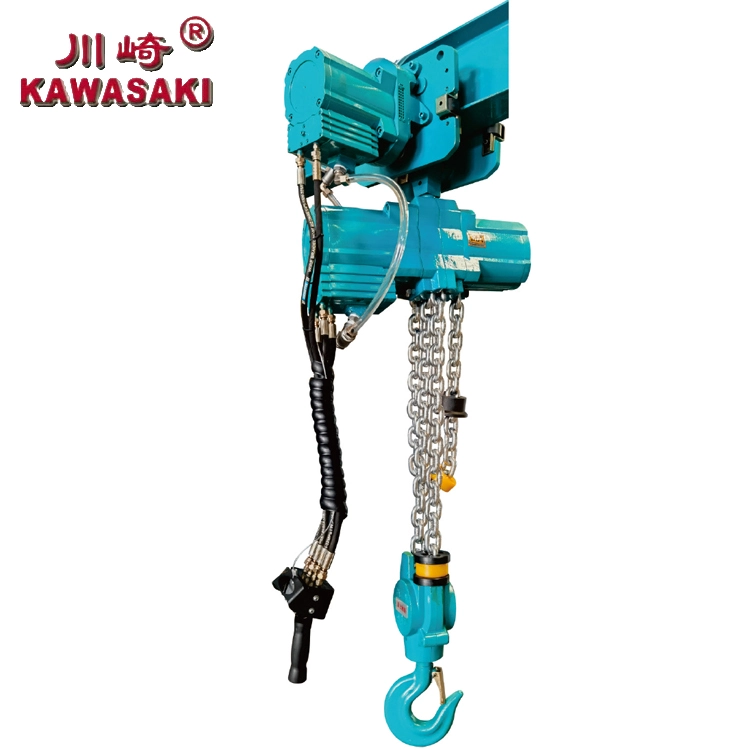
Apollo’s HQ product range includes compressed-air-driven lifting equipment. When a pneumatic solution fits the handling process, the selected pneumatic balance crane should be checked against the actual load, required travel, available air supply, and product specification rather than selected from the application name alone.
When Compressed Air and Workstation Conditions Support a Balancer
A pneumatic balancer also depends on plant infrastructure. Before specifying one, determine whether suitable compressed air is already available at the workstation and verify the pressure, air-consumption, and air-quality requirements for the selected model.
This matters especially in retrofit projects. Installing a pneumatic device may require more than replacing the lifting unit; air lines, treatment equipment, support structure, rail or trolley arrangements, and controls may also need review.
For a new assembly line, these utilities can be considered during layout design. For an existing line, the installed infrastructure can materially affect which lifting technology is practical. Do not assume that pneumatic operation is automatically less expensive than electric operation; installed requirements and operating conditions vary by plant.
When Is an Electric Chain Hoist the Better Choice?
An electric chain hoist is often the more straightforward option when the job centers on repeatable lifting and lowering and does not depend on continuous hands-on fine positioning.
When the Main Requirement Is Controlled Vertical Lifting
Start with the movement path. If a component mainly needs to travel vertically between defined points, and powered up/down control provides sufficient positioning, a conventional electric chain hoist may meet the workstation requirement without adding a balancer-style handling function.
The next questions are capacity, lift height, required speed, horizontal travel, power supply, and operating frequency. Apollo lists multiple electric chain hoists across its electric-hoist product category, allowing the product type to be evaluated separately from the final model and configuration.
This distinction is important for procurement. First decide whether the workstation needs a balancer or a conventional hoist. Only then move into model-level selection.
How Duty Cycle and Production Rate Affect Electric Hoist Selection
Production rate can make an otherwise correctly sized electric hoist unsuitable. A buyer should record lifts per hour, loaded and unloaded travel, lifting and lowering time, starts and stops, shift length, and any periods of concentrated use.
Rated load alone does not describe these conditions. Duty capability should be verified against the specific product specification and expected production cycle.
Once an electric hoist has been identified as the appropriate equipment type, a deeper electric chain hoist selection for production lines can address capacity, duty classification, lifting speed, travel, and other model-specific factors without duplicating the balancer-versus-hoist decision.
Air Balancer vs Chain Hoist Comparison for Assembly Stations
The following comparison is a screening tool, not a substitute for model specifications.
| Selection Factor | Pneumatic / Air Balancer | Electric Chain Hoist |
|---|---|---|
| Primary task | Lifting combined with frequent positioning | Controlled lifting and lowering |
| Operator interaction | Often a major selection factor | Usually less dependent on hands-on positioning |
| Fine alignment | Important reason to evaluate a balancer | Confirm powered control is sufficient |
| Load capacity | Model-dependent | Model-dependent |
| Cycle requirement | Verify against product specification | Verify duty against production cycle |
| Utility | Compressed air | Electrical supply |
| Travel and coverage | Depends on equipment and workstation layout | Depends on hoist, trolley, and support layout |
| Retrofit review | Air, support, tooling, and controls | Power, beam/trolley, duty, and controls |
| RFQ priority | Load + positioning method + air + cycle | Load + lift + duty + travel + power |
Avoid creating a fixed weight boundary such as “below this load use a balancer, above it use a chain hoist.” Product ranges vary, and the handling process may be more important than load alone.
How Cycle Time and Positioning Accuracy Change the Decision
Count Positioning Corrections, Not Just Lifts Per Hour
A fast lifting speed does not automatically create a fast assembly cycle. If the operator spends additional time making small corrections after each lift, the real constraint may be positioning rather than vertical movement.
Observe whether the component must be aligned with bolt holes, inserted into a fixture, connected to another assembly, or held while another operation takes place. Record how many corrections occur and whether pendant-controlled movement causes repeated overshoot or waiting.
This approach answers a more useful question than “Which hoist is faster?” It asks: Which lifting system better matches the complete assembly task?
It also helps prevent replacing an existing electric chain hoist for the wrong reason. If downtime comes from an unsuitable duty rating or travel configuration rather than positioning, changing to a balancer may not solve the underlying problem.
Compressed Air vs Electricity: What Should Buyers Compare?
Compare Installed Requirements Before Comparing Purchase Price
Equipment price is only one part of an assembly-line lifting decision. Compare the infrastructure already available and the changes required to put each option into service.
For a pneumatic system, review compressed-air availability, required treatment, piping, workstation support, controls, and any tooling needed to handle the component. For an electric chain hoist, review power supply, controls, beam or trolley configuration, lift, travel, and production-duty requirements.
Maintenance capability matters as well. A facility already equipped to maintain compressed-air systems may evaluate a pneumatic solution differently from one that would need new infrastructure. The same applies to electrical equipment and controls.
For retrofit projects, existing rail, beam, workstation-crane, utility, and tooling conditions should be documented before requesting quotations. That prevents equipment price from hiding the cost of necessary system changes.
Can a Pneumatic Balancer Replace an Existing Electric Chain Hoist?
When a Retrofit May Be Worth Evaluating
A replacement makes sense to investigate when the existing hoist performs the lift adequately but the workstation still suffers from slow or awkward final positioning. Frequent corrective movements, difficult fixture alignment, or a changed assembly process may indicate that the handling method—not simply hoist capacity—needs review.
Before changing equipment, confirm the load range, lift height, horizontal coverage, air availability, support structure, tooling, and production cycle. If the existing problem is overload, inadequate duty capability, excessive travel, or another specification mismatch, replacing the hoist with a balancer without addressing the root cause can create a different mismatch.
Treat the retrofit as a workstation study rather than a one-for-one equipment swap.
What Should Be Included in an Assembly-Line Lifting Equipment RFQ?
Load, Movement and Production Data Suppliers Need
A useful RFQ should describe the process, not just request “a 500 kg lifting device.” Include:
- Normal and maximum part weight, including whether loads vary
- Required lift height and horizontal travel
- Parts handled per hour or per shift
- Number of positioning corrections during a typical cycle
- Required lifting or lowering speed
- Workstation dimensions and support arrangement
- Available compressed air and electrical supply
- Required tooling, fixture, or end-effector interface
- Operating environment and any project-specific requirements
These details allow a supplier to distinguish between repetitive lifting and repetitive precision positioning.
How to Compare Suppliers Beyond Capacity and Price
A supplier should ask how the load is handled, not only how much it weighs. Useful supplier evaluation points include whether the proposed equipment matches the cycle, whether utility requirements are clearly stated, whether model-level specifications are available, and whether rail, trolley, control, and tooling conditions have been considered.
Apollo Hoist publishes both pneumatic balance-crane products and electric lifting equipment, as well as OEM/ODM service information. That makes it possible to discuss the lifting method before narrowing the project to a single equipment category.
For complex assembly applications, a supplier should also be willing to request missing information instead of recommending equipment solely from load capacity.
Conclusion
The pneumatic balancer vs electric chain hoist decision should begin with the workstation, not the catalog. If operators repeatedly guide and precisely position suspended components, an air balancer deserves evaluation. If the process mainly requires controlled vertical lifting, an electric chain hoist may be the more direct solution. Capacity, cycle rate, travel, utilities, tooling, and existing infrastructure then determine the final specification.
For a new line or retrofit, prepare the part weight, maximum load, lift height, horizontal travel, cycle rate, workstation layout, available air and electrical supply, and positioning requirements before requesting a quotation. Buyers can review the broader lifting-equipment range through Apollo Hoist, then contact Apollo Hoist with the application data needed to evaluate a suitable configuration.
FAQs
Is an air balancer the same as a pneumatic hoist?
Not exactly. Both may use compressed air, but an air balancer is commonly selected when assisted positioning and operator interaction are important. A conventional pneumatic hoist has a different search and selection intent, so product type and control method should be verified before purchase.
Is an air balancer better than an electric chain hoist for assembly work?
It depends on the operation. An air balancer is worth evaluating for repetitive precision positioning, while an electric chain hoist may fit processes dominated by controlled lifting and lowering. Load, cycle frequency, travel, operator interaction, and utilities should all be considered.
Can a pneumatic balancer replace an electric chain hoist?
Potentially, but it should not be treated as a direct one-for-one replacement. Review load, travel, compressed-air availability, workstation support, tooling, positioning requirements, and the reason the existing hoist is being replaced.
Do pneumatic balancers need compressed air?
Yes. A pneumatic balancer requires a suitable compressed-air supply. Required pressure, consumption, and air-quality conditions vary by product and configuration and should be verified against the selected model specification.
What information should be sent to an air balancer or electric hoist supplier?
Provide normal and maximum load, lift height, horizontal travel, production cycle, positioning requirements, workstation dimensions, available utilities, tooling requirements, and relevant environmental conditions. This gives the supplier enough information to compare equipment types rather than quoting from capacity alone.